
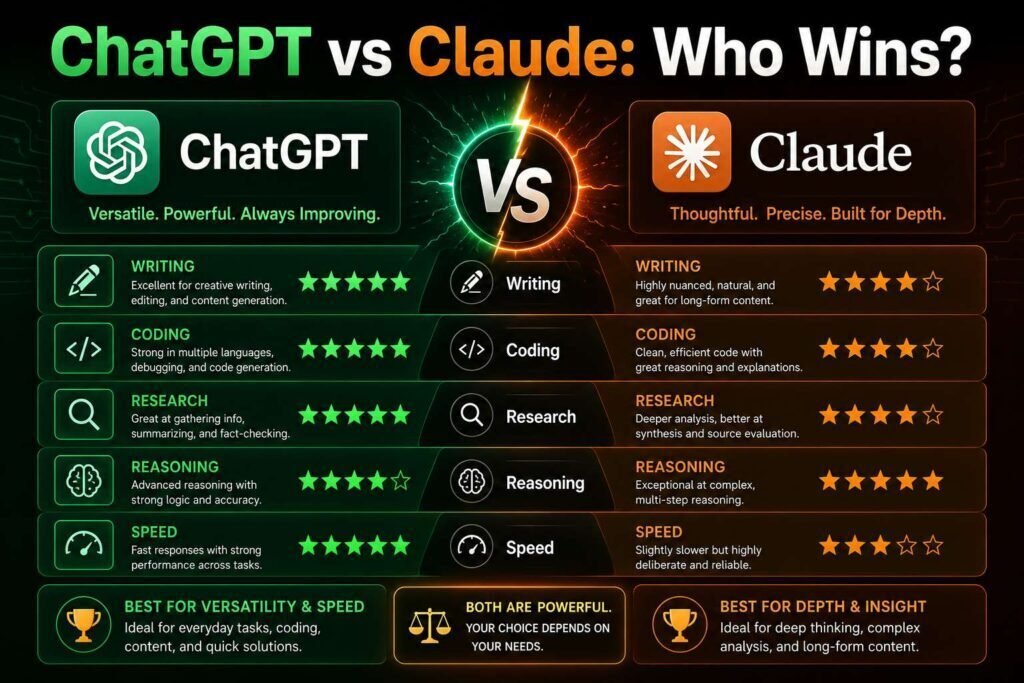
ChatGPT and Claude are the two AI assistants most professionals actually choose between, and the honest answer to “which is better” depends on what your work looks like. This comparison covers where each one wins, based on sustained use of both, with the caveat that both improve every few months and specific model rankings shift.
Quick verdict: ChatGPT is the better all-rounder: more built-in features (image generation, voice, broad app integrations) and the larger ecosystem. Claude is the better specialist for professional writing, careful document analysis, and complex coding work, and many users find its prose and reasoning style noticeably stronger. Power users commonly pay for both; if you pick one, pick it by your dominant task, not by benchmarks.
Key Takeaways
- ChatGPT wins on breadth: images, voice mode, custom GPTs, and the biggest third-party ecosystem.
- Claude wins on depth: writing quality, long-document care, and agentic coding via Claude Code.
- Both cost about $20/month at the individual paid tier, with free tiers good enough to test your real tasks.
- The right test is one week of your actual work in each free tier, not anyone’s benchmark table.
How to Decide Quickly
Benchmarks are a poor way to choose between these two, because the numbers change with every release and rarely reflect your specific work. A far better method takes a week: pick your single most common task, whether that is drafting content, analyzing documents, or writing code, and run it through both free tiers for a few days each. Pay attention to which one needs less editing, which one you trust more on the details, and which one you actually enjoy using. That lived experience beats any comparison table, including the one below, which is best used to know what to test rather than to make the decision for you.
ChatGPT vs Claude at a Glance
| Dimension | ChatGPT | Claude |
|---|---|---|
| Best at | Versatility, multimodal features, ecosystem | Writing, long documents, complex coding |
| Image generation | Built in | No (analysis only) |
| Voice conversation | Mature voice mode | Available, less central |
| Long-document handling | Good | Excellent; large context, careful reading |
| Coding | Strong; Codex/agent features | Strong; Claude Code widely favored for agentic work |
| Custom workflows | Custom GPTs, many integrations | Projects, Artifacts, MCP connectors |
| Free tier | Yes, capable | Yes, tighter daily limits |
| Paid entry (verify) | About $20/month | About $20/month |
Snapshot as of early 2026. Both vendors ship major updates several times a year; verify current capabilities before relying on any row above.
Writing Quality
This is Claude’s clearest win in day-to-day use. Claude’s default prose runs closer to how careful humans write: fewer stock phrases, better adherence to a supplied voice sample, and more willingness to give critical feedback instead of praise. ChatGPT writes well and iterates fast, but its output more often needs de-flavoring, that recognizable AI cadence editors have learned to spot. For marketing copy at volume, either works; for essays, reports, and anything with your name on it, writers consistently lean Claude. The practical tip that matters more than the brand: paste a sample of your real writing and ask either tool to match it, which closes much of the gap. See our AI writing tools guide for the full workflow.
Coding
Both are excellent and the gap changes with each model release. In practice: ChatGPT is quick for snippets, explanations, and one-file problems. Claude has earned particular loyalty for multi-file reasoning, refactoring, and agentic work through Claude Code, which reads a repo, edits files, and runs tests. If your coding is mostly quick questions and single-function help, either serves you well; if it involves navigating a real codebase and making coordinated changes, that is where Claude’s fans point. Whichever you use, review and test the output before shipping. Our AI coding tools roundup and developer alternatives guide go deeper.
Research and Document Handling
ChatGPT’s built-in web browsing and deep-research modes make it the faster start for open-ended research. Claude counters with careful reading: on dense contracts, papers, and specs it preserves qualifications that faster summarizers flatten, and it is more likely to say it is unsure than to confabulate. For document-heavy professions, that behavior difference matters more than any feature. A good rule of thumb: reach for ChatGPT when you need to gather information from the open web, and for Claude when you need to understand a specific document you already have in front of you. Related: Claude vs Gemini for long documents.
Everyday Use and Speed
For quick, everyday questions, both are fast and capable, and the difference here is smaller than in specialist tasks. ChatGPT’s voice mode and image generation make it the more natural companion for casual, multimodal use, such as talking through an idea or generating a quick visual. Claude’s cleaner, less cluttered interface appeals to people who mostly want focused text work without extra features in the way. Neither will disappoint on routine tasks; the deciding factors are the specialist strengths above and which interface you simply prefer to sit in for hours.
Features and Ecosystem
ChatGPT is the fuller product: native image generation, mature voice mode, custom GPTs, memory across chats, and integrations across consumer and business apps. Claude’s ecosystem is thinner but sharper where it aims: Projects for persistent context, Artifacts for interactive outputs, and MCP connectors that let it work with your tools. Teams building AI into their own products will find both APIs first-class. If you want one assistant that also generates images, talks to you, and plugs into many apps, ChatGPT’s breadth is the draw; if you want focused, high-quality text and document work with a few sharp power features, Claude covers it.
Privacy and Data
Both offer consumer tiers where chats may be used for model training unless you opt out, and business tiers where training is off by default. Check the current data controls on each vendor’s site and use business tiers for anything sensitive. Neither should receive client-confidential material on a personal free account. This is the same discipline you would apply to any cloud tool: understand the retention and training settings for your specific plan, and keep regulated or confidential data inside an approved, appropriately configured tier.
Pricing
Both run free tiers and about $20/month individual paid plans, with higher tiers (roughly $100-200/month) for heavy users and per-seat team plans (verify current pricing on both sites). The free tiers are genuinely useful for evaluation; limits, not capability, are what you pay to remove. Because pricing and tier structures change, treat any figure here as a starting point and confirm the current numbers on each vendor’s site before budgeting, especially for team plans where per-seat costs add up.
Which Should You Choose?
- Marketers: ChatGPT for breadth (images, fast iteration); Claude if long-form content quality is the job. Toss-up.
- Developers: Claude, especially for agentic and multi-file work. ChatGPT close behind.
- Writers and editors: Claude.
- Students: ChatGPT free tier for versatility; see our student tools guide.
- Researchers and analysts: ChatGPT for web research speed, Claude for source-document fidelity. Many use both.
- Business teams: whichever integrates with your stack; pilot both business tiers with five users before standardizing.
Getting the Best From Either Tool
Whichever you choose, most of the quality difference in day-to-day use comes from how you prompt, not which logo is on the tab. Give either assistant a clear role, the real context, the format you want, and an example of good output, and both improve dramatically. For writing, paste a sample of your voice and ask it to match. For documents, put the source first and your question last, and ask it to quote the passages behind its answers. For code, supply the language, versions, the actual error, and the surrounding files. Master those habits and you will get strong results from both, which is exactly why the durable difference between them is style and behavior rather than raw capability. Our prompt libraries for ChatGPT and Claude are built around this.
Power Features Worth Knowing
Beyond raw answers, each assistant has features that change how you work. ChatGPT offers custom GPTs you can build for repeated tasks, cross-chat memory, and a large library of third-party integrations, which suits people who want to automate recurring workflows and connect the assistant to other apps. Claude offers Projects, which keep files and instructions together for ongoing work; Artifacts, which render interactive outputs like documents and small apps beside the chat; and MCP connectors that let it act on your own tools. If you like assembling reusable setups, both reward the effort, but in different styles: ChatGPT toward a broad ecosystem, Claude toward focused, high-context workspaces.
Two Real-World Scenarios
Take a content marketer who writes long articles, needs the occasional hero image, and likes talking through ideas out loud. ChatGPT’s breadth, image generation and voice alongside solid writing, makes it a comfortable single tool, though they might keep Claude open for final drafts where prose quality matters. Now take a lawyer or analyst who lives in dense documents and cannot afford a flattened summary. Claude’s careful reading and willingness to flag uncertainty is the safer daily driver, with ChatGPT used for quick web research. Same two tools, different right answer, because the work is different.
Common Mistakes to Avoid
- Choosing on benchmarks. Rankings flip with every release; your real tasks are the only benchmark that matters.
- Expecting one tool to win everything. Each has a clear specialty; match the tool to your dominant task.
- Pasting confidential data into a free personal account. Use business tiers with training off for sensitive work.
- Judging writing quality without a voice sample. Both improve dramatically when you show them how you write.
- Trusting facts without checking. Both can state wrong details confidently; verify anything that matters.
FAQs
Is Claude smarter than ChatGPT?
On some benchmarks and tasks yes, on others no, and rankings flip with each release. The durable differences are style and behavior: Claude’s careful prose and honesty about uncertainty, ChatGPT’s versatility and features.
Can I use both on one budget?
Both free tiers together cover a lot. If you pay for one, pick your dominant daily task; $40/month for both is justified for anyone billing hours with these tools.
Which is better for non-English work?
Both are strong in major languages; test your specific language pair, especially for tone-sensitive work.
Which should a beginner start with?
ChatGPT is the easier first stop for most people because it does more out of the box, including images and voice. Try Claude next if your work centers on writing or documents; the free tiers make trying both cost nothing but time.
Do I need to pay to evaluate them properly?
No. Both free tiers are capable enough to judge fit on your real tasks; the paid plans mainly remove usage limits and add the most capable models. Evaluate free first, then pay only for the one you reach for daily.
Which has the better mobile app?
Both offer capable mobile apps. ChatGPT’s app leans on its multimodal strengths, including voice and images, which makes it a natural on-the-go companion, while Claude’s app suits focused text and document work. Try both on your phone for the tasks you actually do while mobile.
Can these tools connect to my other software?
Yes, both do, in different ways. ChatGPT has a broad ecosystem of integrations and custom GPTs; Claude uses the MCP standard and connectors to work with your tools, and both offer first-class APIs for teams building their own products. Match the integration approach to the tools you already rely on.
How often do these models change?
Frequently, often several times a year, which is exactly why this comparison avoids version-specific claims. Treat any snapshot as temporary, re-run your own quick test after major updates, and choose based on current behavior rather than last year’s rankings.
Our Verdict
There is no universal winner. ChatGPT is the better default for most people because it does more things; Claude is the better tool for the deep-work subset (writing, documents, serious coding) and the one we reach for when quality matters more than features. Run your real work through both free tiers for a week; your answer will be obvious by Friday.
Related Articles
- Claude vs Gemini: Writing, Research, and Coding
- Best ChatGPT Alternatives
- The AdNxt ChatGPT Prompt Library
Sources: official OpenAI and Anthropic product and pricing pages, checked early 2026. Verify current models and pricing before relying on this comparison.