
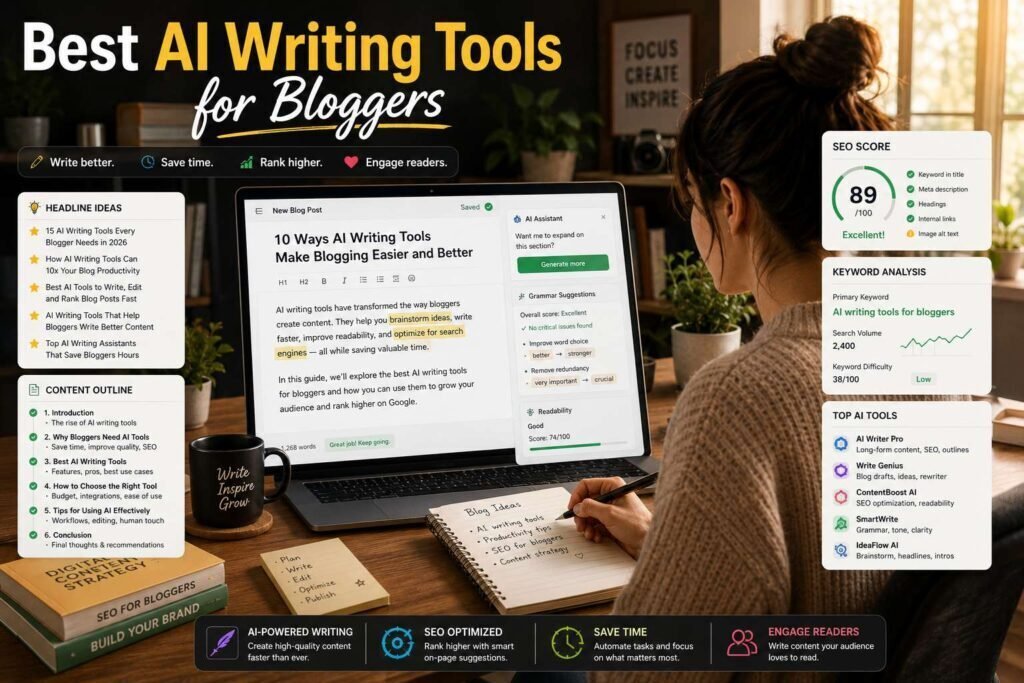
Every blogger now has access to the same AI tools, which means AI-generated sameness is the new baseline to beat, not the edge. The tools below earn their place in a workflow that produces original, useful posts, and this guide is equally clear about what to skip.
Quick answer: Most bloggers need exactly three tools: a general assistant (Claude or ChatGPT, about $20/month) for thinking and drafting, an SEO optimizer (Surfer, from about $79/month, optional until traffic matters), and an editor (Grammarly free or paid). Skip one-click article generators entirely.
Key Takeaways
- A general assistant plus your expertise beats specialized “blog post generators” on quality and cost.
- Claude is favored by many writers for prose quality and voice-matching; ChatGPT for breadth and speed.
- One-click article generators produce content Google’s spam policies explicitly target. Do not build a blog on them.
- The workflow (research, outline, draft, add experience, edit) matters more than the tool brand.
The Real Challenge: Beating AI Sameness
Here is the situation every blogger now faces: your competitors have the exact same AI tools you do. That means AI-generated sameness is the new baseline, not an advantage, and simply prompting a model for “a post about X” produces something indistinguishable from a hundred other sites. The tools below are worth using, but only inside a workflow designed to add what a model cannot: your experience, your data, your opinions, and your voice. Think of AI as the fastest first-draft writer and research assistant you have ever had, and of yourself as the source of everything that makes a post worth reading. The bloggers winning with AI are not producing the most content; they are using AI to publish their genuine expertise faster than they could alone.
Tools at a Glance
| Tool | Role | Price (verify) | Verdict |
|---|---|---|---|
| Claude | Drafting, editing, voice work | Free tier; about $20/month | Best prose quality |
| ChatGPT | Drafting, research, images | Free tier; about $20/month | Best all-rounder |
| Jasper | Brand-voice content for teams | From about $39/seat/month | For teams, not solo bloggers |
| Surfer | SEO optimization | From about $79/month | Worth it once SEO traffic pays |
| Grammarly | Final edit pass | Free; premium about $12/month | Keep it |
| Hemingway | Readability pass | Free web; paid app | Cheap and useful |
| One-click generators | Mass articles | Varies | Skip |
The Core: Claude or ChatGPT
For blogging specifically, Claude has earned a reputation for stronger prose: it matches a provided voice sample more faithfully, produces fewer telltale AI phrases, and gives genuinely critical feedback on drafts instead of praise. ChatGPT counters with breadth: built-in web browsing for research, image generation for featured graphics, and fast iteration. Either works; serious writers often test both against one real post and keep the winner. Both run free tiers and about $20/month paid (verify).
How to use it well: feed it your outline and expertise, not just a topic. “Write a post about email deliverability” produces the same post everyone else has. “Here are my six findings from fixing deliverability for 40 client domains; draft sections around them in my voice (sample attached)” produces something only you could publish.
Using AI for Research Without Getting Burned
AI is a genuine accelerator for research, as long as you treat it as a starting point rather than a source of truth. It is excellent for gathering angles, summarizing material you paste in, clustering subtopics, and pointing you toward what a post should cover. What it must never do is supply facts, statistics, or citations you publish without checking, because models fabricate convincing but false references and confidently misstate figures. Build a simple rule into your workflow: every number, quote, price, and claim the AI produces gets verified against a primary source before it ships. Tools like ChatGPT with browsing or a research assistant with citations reduce the risk, but the responsibility stays with you. Fast research plus disciplined verification is the combination that keeps AI-assisted blogging both quick and trustworthy.
Repurposing Your Best Posts
One of AI’s highest-leverage uses for bloggers is not writing new posts but multiplying the ones you already have. A single strong article can feed a week or more of content: a general assistant will turn it into a set of social posts, an email newsletter, a short video script, and a discussion prompt, each adapted to its format rather than copy-pasted. Because the substance already exists and is yours, this repurposing is fast and keeps your quality high across channels. Make it a habit after publishing anything substantial, and you extend the reach of your best work without the effort of creating from scratch each time, which is exactly the kind of leverage AI is best suited to provide.
When Jasper Makes Sense
Jasper adds brand-voice training, campaign templates, and team workspaces on top of the same underlying models. Solo bloggers rarely need that layer; content teams with multiple writers producing on-brand posts at volume are the actual customer. From about $39/seat/month (verify).
SEO Layer: Surfer
Surfer scores your draft against current top-ranking pages for coverage, headings, and terms, integrating with Google Docs and WordPress. It will not save a weak article, but it reliably surfaces subtopics you forgot. Worth the roughly $79/month once organic traffic is a revenue line; premature before that (verify pricing).
Edit Layer: Grammarly and Hemingway
Run every post through a mechanical edit (Grammarly) and a readability pass (Hemingway highlights sentences that make readers work). Ten minutes here is the difference between “AI-assisted” and “AI-obvious.” Then read it aloud once; your ear catches what tools miss.
What to Skip: One-Click Article Generators
Tools promising “100 SEO articles while you sleep” produce exactly the scaled content abuse Google’s spam policies name and periodically wipe from the index. Sites built on them show the same pattern: brief traffic, then a core-update cliff. If your plan involves publishing anything unread by a human, change the plan.
Making AI Sound Like You
The difference between “AI-assisted” and “AI-obvious” is usually voice, and it is fixable. Stop describing your voice and start showing it: paste 500 words of your best writing and tell the assistant to match the tone, sentence rhythm, and word choices. Ban the phrases you dislike, the “in today’s fast-paced world” openings and the “unlock” and “elevate” filler, and ask for plain, specific language. Then read the draft aloud; anywhere you stumble or wince is a line to cut. Claude is often preferred here for how faithfully it matches a sample, but any capable model improves dramatically with a real voice sample and a firm edit. This one habit does more to de-genericize AI writing than switching tools ever will.
Your Experience Is the Moat
Search increasingly rewards content that demonstrates real experience and expertise, which is precisely what a language model cannot manufacture. This is good news for bloggers, because it turns your background into your competitive advantage. Wherever a post touches something you have actually done, add the specifics only you have: the numbers from your own results, the mistake you made and what it taught you, the screenshot from your own dashboard, the opinion you will defend. AI can structure and draft around those specifics, but it cannot invent them, and they are exactly what makes a post rank, get linked, and get remembered. Treat the “add my real experience” step as the most important one in your workflow, not an optional polish.
A Workflow That Actually Works
- Research: gather your own experience, data, and 3-5 primary sources. AI can summarize sources; only you supply experience.
- Outline: draft it yourself, then ask the assistant what a reader searching your keyword would still be missing.
- Draft: AI drafts sections from your outline and notes, in your voice (paste a 500-word sample).
- Humanize: add the examples, opinions, numbers, and screenshots only you have. This step is the moat.
- Optimize: Surfer pass if you use it, natural internal links (see our marketing tools guide for the wider stack).
- Edit: Grammarly, Hemingway, read-aloud. Verify every fact and price the AI touched.
Common Mistakes to Avoid
- Publishing AI drafts unedited. The fastest route to generic content and a core-update cliff; the human edit and your experience are the point.
- Using one-click article generators. They produce exactly the scaled content abuse search spam policies target; do not build a blog on them.
- Prompting with a topic instead of your outline and expertise. Generic input produces the same post everyone else has.
- Skipping fact-checking. AI invents plausible stats and prices; verify everything it touches before publishing.
- Buying tools before you need them. A general assistant is enough until traffic pays; add an SEO tool then, not before.
FAQs
Does Google penalize AI-written content?
Google targets low-quality scaled content, whoever wrote it. Helpful, original, experience-backed posts rank regardless of drafting tool; mass-generated filler gets hit in core updates regardless of disclosure.
Claude or ChatGPT for blogging?
Test both on one post in your voice. Writers who care most about prose tend to land on Claude; bloggers who want research, images, and drafting in one place lean ChatGPT.
How much should a solo blogger spend on AI tools?
About $20/month until organic traffic pays real money; then add Surfer. Spending more before then buys convenience, not rankings.
Should I disclose that a post was written with AI?
Follow your own standards and any platform rules, but focus your energy on quality and accuracy, which is what readers and search engines actually care about. Many bloggers treat AI like a word processor or spell-check, tools that assist the writing rather than something requiring a disclaimer, while being scrupulous that the experience, opinions, and facts are genuinely theirs and correct.
Can AI help with headlines and post ideas?
Yes, and it is a great use. A general assistant will generate dozens of headline variations and topic ideas from your niche and audience notes, which is far faster than brainstorming alone. Treat its suggestions as raw material to refine with your judgment about what your readers actually respond to, rather than accepting the first list it produces.
Can I build a whole blog with AI?
You can draft and research far faster with AI, but building a blog entirely on unread, mass-generated content is the pattern search engines target and periodically wipe from the index. The durable approach is to use AI to publish your genuine expertise faster, adding your experience, examples, and a human edit to every post, rather than to replace the writing and thinking that make a blog worth reading.
Is Claude or ChatGPT better for bloggers?
Test both on one real post in your voice and keep the winner. Writers who care most about prose quality and voice-matching tend to land on Claude; bloggers who want research, image generation, and drafting in one place often prefer ChatGPT. Both are capable, and the free tiers make the comparison cost only your time.
Do I need an SEO tool like Surfer?
Not at first. A general assistant plus your own keyword research covers early blogging, and Surfer earns its cost once organic traffic is a real revenue line, by scoring drafts against what ranks and surfacing subtopics you missed. Add it when traffic justifies the spend, not before, because it optimizes good content rather than creating it.
How do I keep my writing from sounding like AI?
Give the model a real voice sample and tell it to match, ban the filler phrases you dislike, add your own examples and opinions, and read every post aloud before publishing. The generic feel comes from generic input and skipped editing; specificity in your prompt and a firm human edit are what make AI-assisted writing sound like you.
Our Verdict
Buy one general assistant, keep Grammarly, add Surfer when traffic justifies it, and skip article generators entirely. The bloggers winning with AI are not the ones producing the most content; they are the ones using AI to publish their actual expertise faster.
Related Articles
- Best AI Tools for Marketing Teams
- Claude vs Gemini for Long Documents
- ChatGPT Alternatives for Developers
Sources: official pricing pages, checked early 2026. Verify current pricing before subscribing.