
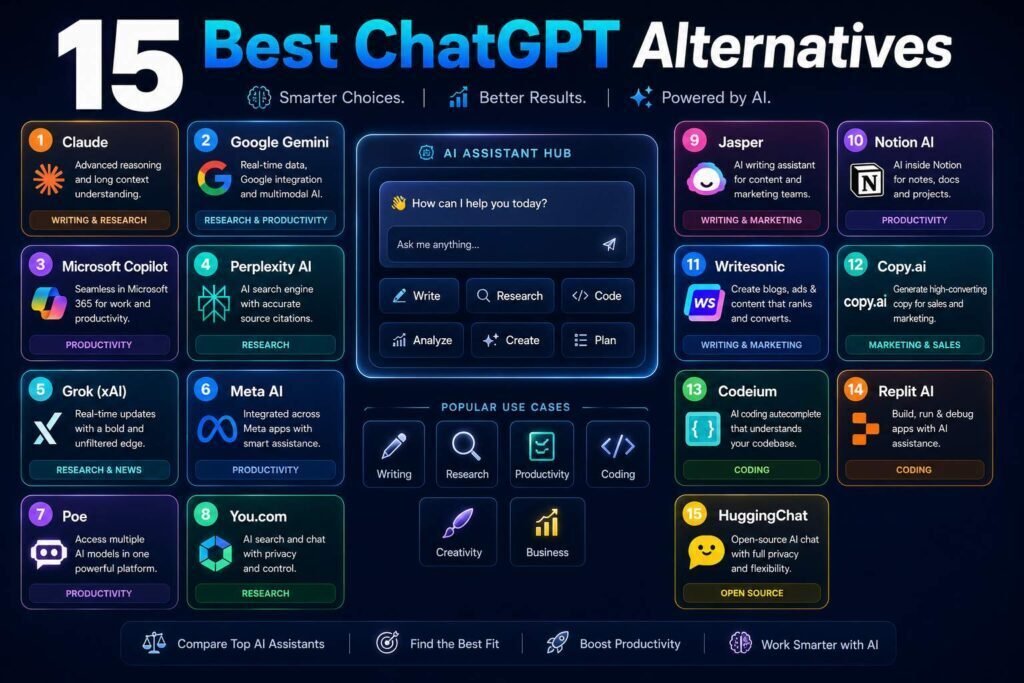
ChatGPT is excellent, but it is no longer automatically the right tool. Depending on whether you value writing quality, research with citations, privacy, or price, a different assistant may serve you better. Here are fifteen alternatives worth knowing, grouped by what they do best.
Quick answer: The strongest overall ChatGPT alternative is Claude (writing, analysis, coding). For research, Perplexity and Gemini. For privacy, local models via Ollama. For free, Gemini and Microsoft Copilot. Developers should also see our dedicated developer guide.
Key Takeaways
- Claude is the top alternative for quality writing and careful analysis.
- Perplexity is the best research-first alternative thanks to cited answers.
- Gemini offers the most generous free access of the frontier assistants.
- For confidential work, local models (Ollama) keep data on your machine.
Why Consider a ChatGPT Alternative
ChatGPT set the standard, but the field has caught up and, in specific areas, pulled ahead. There are four common reasons to look elsewhere. You may want higher writing quality, where a more voice-faithful assistant saves editing time. You may want research you can trust, where inline citations let you verify rather than take answers on faith. You may want privacy, where keeping data on your own machine sidesteps the whole cloud question. Or you may simply want more for free, where a generous free tier covers your needs without a subscription. This guide groups the alternatives by exactly those motivations, so you can jump to the reason that fits you.
The 15 at a Glance
| Tool | Best for | Price (verify) |
|---|---|---|
| Claude | Writing, analysis, coding | Free; about $20/month |
| Gemini | Free access, Google ecosystem | Generous free; about $20/month |
| Perplexity | Research with citations | Free; about $20/month |
| Microsoft Copilot | Free GPT-class in Windows/Office | Free; Copilot Pro tiers |
| DeepSeek | Free reasoning and coding | Free; low-cost API |
| Mistral Le Chat | Fast European alternative | Free; paid tiers |
| Meta AI (Llama) | Free, open-model backed | Free |
| Grok | Real-time, X-integrated | Free limits; X Premium |
| Poe | Many models in one app | Free; about $20/month |
| You.com | Research + model choice | Free; paid tiers |
| HuggingChat | Open-source model access | Free |
| Ollama (local) | Privacy, offline | Free |
| Pi | Conversational support | Free |
| Jasper | Team marketing content | From about $39/seat/month |
| NotebookLM | Research from your own sources | Free |
Best for Writing: Claude
Claude produces the most natural, voice-faithful prose of any mainstream assistant and gives genuinely critical feedback on drafts. For essays, reports, and long-form content it is the clearest upgrade from ChatGPT. Detail in our ChatGPT vs Claude comparison.
Best for Research: Perplexity and Gemini
Perplexity answers with inline citations, making it a research engine rather than just a chatbot. Gemini grounds answers in Google Search and offers Deep Research modes. Both reduce (not eliminate) hallucination; verify sources regardless. NotebookLM is unbeatable when you want answers strictly from documents you upload.
Best Free: Gemini, Copilot, DeepSeek
Gemini’s free tier is the most generous of the frontier models. Microsoft Copilot puts GPT-class help free inside Windows and Office. DeepSeek offers strong free reasoning and coding, though business users should weigh data-residency considerations.
Best for Privacy: Ollama and Open Models
Ollama runs open models (Llama, Qwen, Mistral, DeepSeek) locally: nothing leaves your machine, no subscription, full control. Quality trails the frontier but closes monthly. For regulated or confidential work, this sidesteps the data question entirely.
Best for Teams and Marketing: Jasper
Not every alternative is a general assistant. Jasper is built for marketing teams that produce content at scale, layering brand voice, templates, workflows, and collaboration on top of the underlying models. It costs more than a consumer assistant, from about $39 per seat per month, and for a solo user a general tool like Claude or ChatGPT usually makes more sense. But for a team that needs consistent brand voice across many contributors and a workflow around content production, that structure is the point. Match the tool to the shape of your work: individuals want a capable generalist, while content teams may value the guardrails and collaboration a purpose-built platform provides.
Best for Everyday Questions on Any Device
For quick, everyday help, the most convenient alternative is often the one already on your device. Microsoft Copilot puts capable assistance inside Windows and Office at no cost, Gemini is built into Android and Google apps, and Meta AI is free across Meta’s apps. Pi offers a friendlier, more conversational style for lighter use. None of these needs to be your main work tool, but for the constant small questions that fill a day, reaching for the assistant already integrated into what you are using beats opening a separate app. Convenience is a feature, and for casual use it often outweighs small quality differences.
Best for Coding: Claude and DeepSeek
If your main reason to leave ChatGPT is code, two alternatives stand out. Claude is widely favored for reasoning through code, refactoring, and agentic multi-file work, and its explanations of unfamiliar code are excellent. DeepSeek offers strong free reasoning and coding, which makes it attractive on a budget, though business users should weigh data-residency considerations before adopting it. For a deeper look at the developer-specific options, including editor integrations and agents, see our ChatGPT alternatives for developers guide, which covers the coding landscape in detail. Whichever you use, review and test generated code before shipping it.
Multi-Model Aggregators
Poe and You.com let you switch among many models under one subscription, useful for comparing outputs without juggling accounts. HuggingChat offers free access to open models.
Understanding the Trade-offs
Choosing an alternative usually means balancing three things that rarely come together in one tool: capability, privacy, and price. The frontier assistants offer the most capability but run in the cloud and meter their best models. Local open models via Ollama offer privacy and no cost but trail the frontier on quality, though that gap narrows monthly. Free tiers of the big assistants offer strong capability at no price but come with usage limits and consumer data terms. There is no single winner, only the right trade-off for a given task: reach for a frontier tool when quality matters most, a local model when data cannot leave your machine, and a generous free tier for everyday work where limits rarely bite.
Which Should You Choose?
- Writers: Claude.
- Researchers: Perplexity or Gemini, plus NotebookLM for your own sources.
- Developers: Claude or DeepSeek; see the developer guide.
- Budget: Gemini, Copilot, DeepSeek.
- Privacy-critical: Ollama locally.
Switching Without Losing Your Workflow
The friction of leaving ChatGPT is smaller than it feels, because most of your skill transfers. The prompting habits that work, giving a clear role, real context, the format you want, and an example to match, work on every assistant here. Custom instructions and saved prompts move over as plain text. The main things that do not transfer automatically are tool-specific features like custom GPTs, memory, or integrations, so before switching, note the handful of features you actually rely on and confirm the alternative covers them. In practice, many people do not switch fully at all; they keep a free ChatGPT account for its strengths and add a second tool for writing, research, or privacy.
Two Real-World Scenarios
Consider a freelance writer tired of editing generic drafts. Their reason to switch is quality, so Claude is the clear move, with a free Perplexity account for fact-checking and research. They may never open ChatGPT again, or keep it only for quick images. Now consider a consultant handling confidential client documents who cannot put that material in the cloud. Their reason is privacy, so a local model via Ollama is the right base, accepting slightly lower ceiling quality in exchange for data never leaving their machine, with a frontier free tier for non-sensitive tasks. Same starting point, different alternative, because the motivation, not the brand, drives the choice.
Common Mistakes to Avoid
- Chasing the most famous name. The best assistant is the one matched to your dominant task, not the biggest brand.
- Trusting research answers without opening sources. Citations reduce hallucination; they do not eliminate it. Verify what matters.
- Putting confidential data in a free consumer tier. Use business tiers with training off, or a local model, for sensitive work.
- Paying before testing free. Most alternatives have capable free tiers; evaluate on your real tasks before subscribing.
- Judging writing without a voice sample. Any of these improves dramatically when you show it how you write.
FAQs
Is any ChatGPT alternative completely free?
Yes: Gemini, Microsoft Copilot, DeepSeek, and Meta AI all offer capable free access; Ollama is free and private.
Which alternative is best overall?
Claude for most knowledge work. Test it against your real tasks in the free tier.
Can I use several at once?
Many people do: Claude for writing, Perplexity for research, a free tool for quick questions. Aggregators like Poe simplify this.
Are multi-model aggregators like Poe worth it?
They can be, if you regularly want to compare outputs from several models or dislike juggling accounts. One subscription gives you access to many models in a single app. If you have settled on one or two assistants, though, going direct is usually simpler and may cost less.
Do I lose my ChatGPT history and custom setups if I switch?
Your prompting skill transfers to any alternative, but tool-specific features like custom GPTs, memory, and integrations do not move automatically. Before switching, note the few features you truly rely on and confirm the alternative covers them; many people keep a free ChatGPT account alongside their new tool rather than fully leaving.
Which alternative is best for privacy?
Running open models locally with Ollama is the most private option, since nothing leaves your machine and there is no subscription. It trails the frontier on the hardest tasks and needs your own hardware, but for confidential or regulated work it sidesteps the cloud-data question entirely, which is often worth the trade.
Which alternative is easiest to switch to from ChatGPT?
Claude and Gemini feel the most familiar and require almost no relearning; your prompting habits transfer directly. Try whichever matches your main task, writing and analysis lean Claude, Google ecosystem and free access lean Gemini, and keep ChatGPT for anything you still prefer it for.
Are open-source or local models good enough to replace ChatGPT?
For many tasks, yes, and the gap narrows every month. Local models via Ollama handle a lot of writing, coding, and analysis while keeping data private, at the cost of trailing the frontier on the hardest problems and needing your own hardware. For confidential work, that trade is often worth it.
Do I have to pick just one?
No. Many people run a small combination: a quality writer, a research tool, and a free everyday assistant, sometimes through an aggregator like Poe that puts several models under one subscription. Match tools to tasks rather than forcing one assistant to do everything.
Is Perplexity better than ChatGPT for research?
For research specifically, many people prefer it, because it answers with inline citations you can open and check, which turns it into a research engine rather than a chatbot. It still requires you to verify the sources, but the workflow of “answer plus links” is well suited to research where trust matters.
What is the best free ChatGPT alternative?
Gemini has the most generous free tier of the frontier assistants, and Microsoft Copilot puts capable help free inside Windows and Office. DeepSeek and Meta AI are strong free options too. For private free use, Ollama runs open models locally at no cost.
Will these alternatives keep changing?
Yes, quickly. Models and pricing shift every few months, which is why this guide groups tools by durable strengths, writing, research, privacy, and price, rather than version numbers. Re-check the specifics before subscribing, but the reasons to pick each tend to hold.
Our Verdict
If you leave ChatGPT for one tool, make it Claude for quality or Gemini for free access. Add Perplexity for research and Ollama for privacy. The best assistant is the one matched to your dominant task, not the most famous name.
Related Articles
Sources: official product and pricing pages, checked early 2026. Verify current models and pricing before subscribing.