
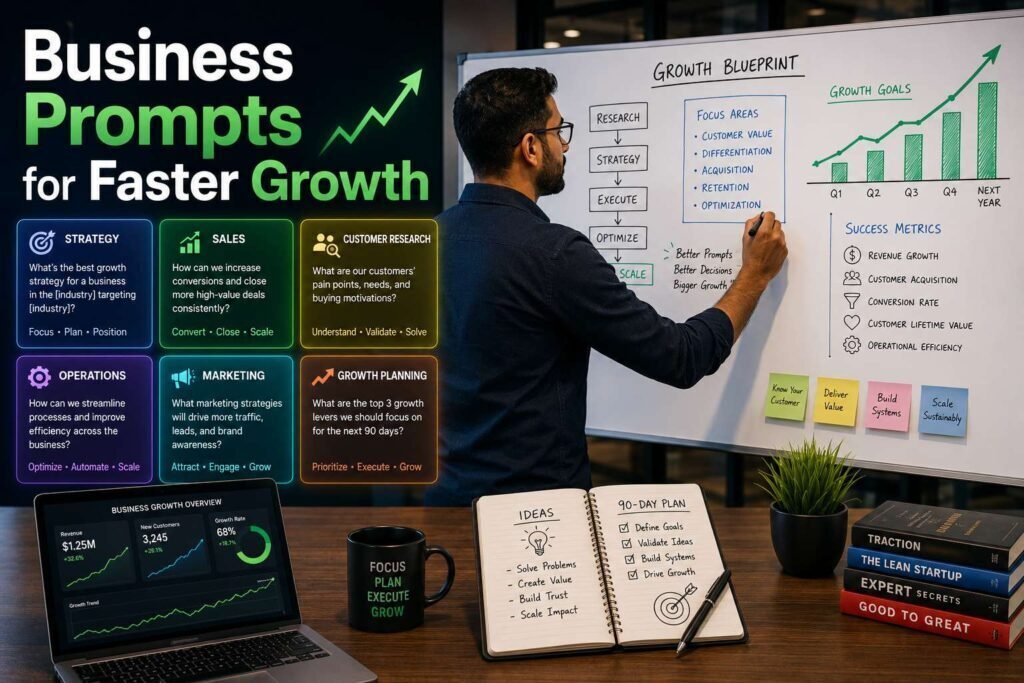
These prompts turn an AI assistant into a useful thinking partner for running and growing a business. They work best when you give real context and ask the AI to challenge you, not flatter you. Below you will find a short method for getting useful answers, tested prompts grouped by function, and a clear-eyed note on where judgment still has to win. Replace [variables] and verify any facts or figures it provides.
How to Use
- Give real numbers and context; the output is only as good as the input.
- Ask the AI to argue against your plan, not just support it.
- Treat output as a draft to pressure-test, not a decision to follow blindly.
How to Get Useful Business Answers
The most common failure with business prompts is generating polished documents that never change what you do. A few adjustments fix that. Give the AI your real numbers and constraints, not a vague summary, so its analysis is grounded. Ask it to argue against its own recommendation (“what would have to be true for this to fail?”) so you see the risks before committing. End strategy prompts by forcing a choice: “recommend one option and the first action I should take this week.” And require owners and dates on any plan, because a plan without them is just a wish list. The goal is momentum, not paperwork: every prompt should leave you with a decision made or an action ready to take.
Planning and Strategy
Customer Research and Validation
Sales
Operations
Finance and Pricing
Growth and Marketing
For channel-specific prompts, see the Marketing Prompt Library.
Hiring and Team
Fundraising and the Pitch
Negotiation and Partnerships
Meetings and Decision-Making
Investor and Stakeholder Communication
Customization tip: give it your real numbers and let it structure the narrative; never let it invent metrics.
Productivity and Delegation
Customer Support and Retention
Legal, Finance, and Compliance: Where to Be Careful
Some business questions are exactly the ones you should not settle with an AI answer alone. Tax treatment, contracts, employment law, licensing, and regulatory compliance vary by jurisdiction and change over time, and a confident-sounding but wrong answer here is expensive. Use these prompts to prepare — to draft questions for your accountant or lawyer, summarize a document so you understand it before a call, or list the issues you should ask about — but treat the output as a starting point, not advice. For anything binding or high-stakes, verify with a qualified professional, and never paste confidential contracts or financials into a consumer tool that has not been approved for that data.
Worked Example: A Prompt That Forces a Decision
Business prompts fail when they produce a tidy essay you nod at and then ignore. The fix is to demand an outcome. Instead of “give me a marketing strategy,” try: “Given my budget of [X], audience [Y], and goal [Z], recommend the single channel to focus on next month, the first three actions with owners and dates, and the one metric that tells me it is working. Then argue why this plan might fail.” That prompt ends with a decision, a short action list, and a built-in risk check, which is the difference between thinking and doing. Every strategy prompt in this library is written to push you toward a choice you can act on this week.
Where AI Belongs, and Where Judgment Wins
AI has become a capable business co-pilot, but it works best when you are clear about which seat it occupies. Hand it the analytical and drafting load: structuring options, summarizing information, drafting communication, documenting processes, modeling scenarios from numbers you provide, and pressure-testing your thinking. In those roles it is fast, tireless, and genuinely helpful. Keep for yourself the things that require accountability and context it does not have: final decisions, financial commitments, people matters, and anything legal or high-stakes. The model has no skin in the game, no access to the unwritten context of your market and team, and a tendency to sound confident even when it is wrong. Owners who get the most from it use it to think faster and clearer, then make the call themselves.
Start Small, Then Expand
If you are not sure where AI fits in your business, start where the work is repetitive and low-risk, and grow from there. Pick one recurring task that drains time but rarely requires deep judgment, such as summarizing meetings, drafting first versions of routine documents, or turning notes into clean communication. Build one reliable prompt for it, use it for a week, and measure the time saved. Once that habit sticks, move up to structuring decisions and analyzing your own numbers, always keeping the final call with you. The mistake is trying to automate everything at once; the win is compounding, one dependable prompt at a time, until AI quietly handles a meaningful slice of your week and frees you for the work only you can do.
A Weekly Founder Workflow
The value compounds when these prompts become a routine rather than one-off queries.
- Monday: triage the task list into priorities, delegate, and drop.
- Midweek: pressure-test the biggest decision with a trade-off analysis.
- Friday: draft a stakeholder or team update from your real numbers.
- Monthly: review what worked, and refine the prompts you reuse.
Common Mistakes
- Treating AI output as fact. Verify figures and market claims independently.
- Asking for validation instead of honest critique.
- Skipping context; generic input gives generic strategy.
- Producing documents that never turn into a decision or an action.
FAQs
Can AI make business decisions for me?
No. It is a thinking partner that surfaces options, risks, and blind spots. You decide, ideally with verified data.
Which AI is best for business use?
Claude and ChatGPT both excel at strategy discussions; see our comparison. Use business tiers for confidential data.
Is it safe to paste financials and strategy into AI tools?
Only within tools your business has approved, with an understanding of their data-retention and training settings. Avoid pasting sensitive numbers or confidential plans into consumer tools without that clearance.
What if I am a solo founder or small team?
These prompts work even better solo, because you are the analyst, marketer, and operator at once. Use AI to cover the roles you have least time for, and lean on the weekly workflow to keep a rhythm without extra headcount.
Which business tasks are safest to hand to AI first?
Start with drafting and structuring: first drafts of documents, summaries, plans, and communication. Keep final judgment and anything legal or high-stakes under human review. See how to automate tasks with AI.
How do I stop getting generic strategy advice?
Generic input produces generic output. Give it your specific market, constraints, numbers, and competitors, and ask it to challenge your assumptions rather than agree with them. The worked example above shows the difference a specific, decision-forcing prompt makes.
What is the fastest way to get value from these prompts?
Take one recurring headache, such as your weekly priorities or a stakeholder update, and run it through the matching prompt until it reliably saves you time. Build the habit on that one win, then expand into research, strategy, and operations.
Keep Growing
Use these prompts to think faster and see blind spots, then verify and decide. Pair with the right CRM and automation tools to execute.