
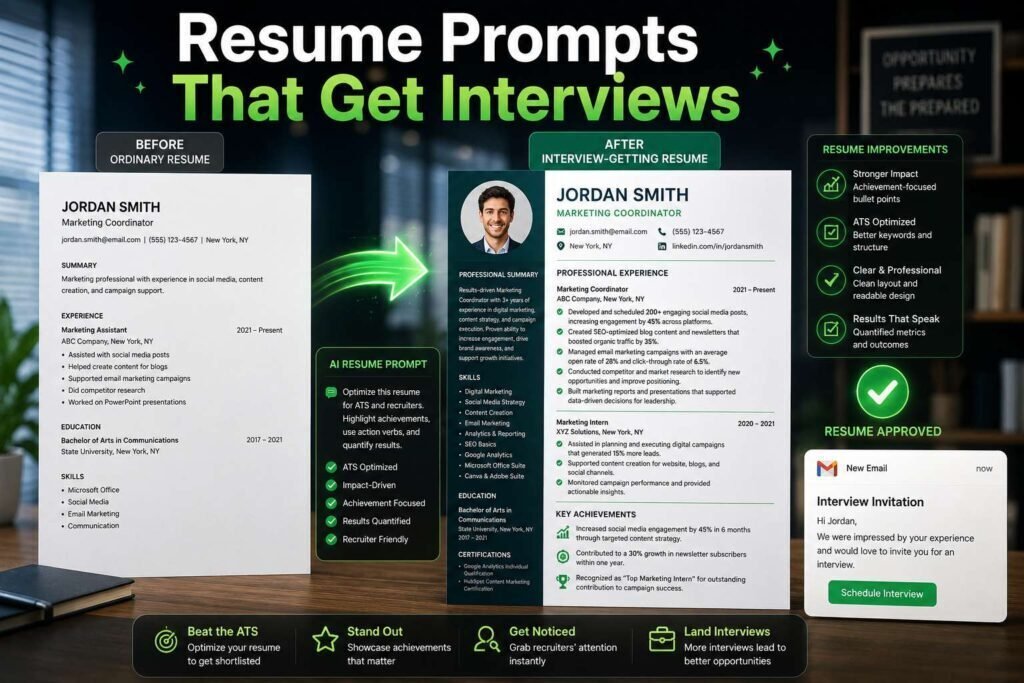
AI can dramatically improve how you present real experience, and it can get you rejected if you let it invent things. These prompts help you write stronger, honest resumes, tailor them to jobs, beat applicant tracking systems, and prepare for interviews. Replace [variables] with your real details, and never let AI fabricate credentials or experience you do not have.
How to Use
- Feed the AI your real experience; it sharpens presentation, it does not invent facts.
- Always tailor to the specific job description for best results.
- Keep it truthful: fabricated experience surfaces in interviews and reference checks.
What Actually Gets You Interviews
Before the prompts, it helps to know what a resume is really for: getting a short conversation, not summarizing your whole history. Three things move that needle more than any formatting trick. The first is tailoring — a resume aimed at a specific role, using that posting’s language and leading with the most relevant experience, beats one generic version sent everywhere. The second is achievements over duties: hiring managers skim for impact, so “cut onboarding time 30% by rebuilding the training flow” beats “responsible for onboarding.” The third is the network — a referral does more than any keyword. AI can accelerate all three, but the substance has to be yours and true.
Writing Resume Bullets
Tailoring to a Job
Beating the ATS
Reality check: keywords only help if they are true. Never add skills you do not have; it fails fast in interviews.
Cover Letters
Interview Preparation
Salary Negotiation
Thank-You Notes and Follow-Ups
LinkedIn and Networking
References and Recommendations
Staying Organized in Your Search
Career Changes and Employment Gaps
Customization tip: give the AI your real story; it can frame it honestly, but it should never invent history.
Portfolio and Personal Brand
Common Resume Myths, Corrected
Plenty of resume advice is outdated, and following it quietly hurts you. “One page, always” suits early careers, but experienced professionals can use two pages if every line earns its place. “List every responsibility” is backwards; recruiters skim for achievements and impact, not job-description duties. “A creative design stands out” often backfires, because heavy graphics and multi-column layouts break the applicant tracking systems that read your resume first, so clean and readable wins. And a generic objective statement wastes your most valuable space; a short, targeted summary of the value you bring to this specific role does far more. When in doubt, choose clarity and truth over cleverness.
Worked Example: A Bullet That Gets Noticed
Watch what a good prompt does to a weak bullet. Start with “Responsible for managing the company’s social media accounts.” Ask the AI to rewrite it as an achievement using your real numbers, and you get “Grew Instagram engagement 42% in six months by shifting to short-form video and a consistent posting schedule.” Same job, but the second version leads with a result, quantifies it, and names how you did it. That is the whole game: hiring managers skim for impact, so every bullet should answer “what changed because I was there?” Feed the AI your genuine accomplishments and it will help you phrase them that way, without inventing anything.
Using AI Ethically in Your Job Search
AI is a legitimate job-search tool, in the same way spell-check and resume templates always have been, as long as you use it honestly. The line is simple: let it help you express your real experience clearly, but never let it invent history, fabricate skills, or manufacture achievements you cannot back up in an interview. Padding a resume with keywords for skills you lack might pass an automated scan, but it collapses the moment a competent interviewer probes it, and it damages your credibility. Used well, AI helps you present a true story in its strongest form, tailored to each role and free of the errors and awkward phrasing that quietly sink applications.
A One-Hour Resume Refresh
- 10 min: paste your resume and the target job; get a gap analysis.
- 20 min: rewrite your top three roles as achievements with real numbers.
- 10 min: tailor the summary and skills to the posting’s language.
- 10 min: run an ATS formatting check and fix flagged issues.
- 10 min: proofread every line yourself and confirm all facts are true.
Keep the detailed master resume; you will reuse it for every application and only re-tailor the top.
Landing Interviews Faster
It is worth stepping back from resume mechanics to remember what actually shortens a job search. Applying to many roles with one generic resume feels productive but rarely works; a smaller number of genuinely tailored applications, aimed at roles you are a real fit for, converts far better. Pair each application with a human touch where you can: a brief, specific note to someone at the company, a referral, or a thoughtful message to the hiring manager. Use the prompts here to move fast on the mechanics, tailoring, rewriting bullets as achievements, prepping for interviews, so you can spend your energy on the part that moves the needle, which is targeting the right roles and reaching real people. Speed on the busywork plus focus on fit and relationships is the combination that gets interviews.
Common Mistakes
- Letting AI invent metrics or experience. Keep everything true.
- Sending a generic resume; always tailor to the posting.
- Over-polishing until it sounds robotic. Keep your voice.
- Padding to fill space or shrinking fonts to cram; hiring managers notice both.
FAQs
Will recruiters know I used AI?
They care about substance and honesty, not the tool. An AI-polished resume of real achievements is fine; a fabricated one fails at interview.
Can AI tailor my resume to beat ATS filters?
It can align real experience with a job’s keywords, which helps. It cannot ethically manufacture qualifications you lack.
Should my resume be one page?
It depends on experience. Students and early-career applicants should aim for one; seasoned professionals can justify two if the content is relevant and tight. Never pad to fill space.
Should I include a photo?
In many regions a photo is discouraged and can introduce bias, and some ATS software struggles with images. Unless it is standard in your country or industry, leave it off.
How many versions of my resume should I keep?
One detailed master resume, then a tailored version per role or job type. Re-tailoring from the master takes minutes and consistently beats one generic resume sent everywhere.
How do I handle references on the resume itself?
You generally do not need “references available on request”; it wastes a line everyone assumes anyway. Keep a separate reference list, share it when asked, and give each reference a heads-up and a quick reminder of the role so their answer is specific.
Can I use these prompts for an internal promotion or career pivot?
Yes. For an internal move, highlight cross-functional wins the hiring manager already knows about; for a pivot, use the transferable-skills prompts to reframe your experience in the new field’s language. The method is the same: start from your real record and match it to the specific opportunity.
How long should the whole tailoring process take per application?
Once you have a master resume, tailoring for a specific role takes roughly an hour with these prompts: a gap analysis, rewriting your top roles as achievements, matching the summary and skills, and a formatting and proofreading pass. That hour consistently beats firing off one generic resume everywhere.
Should I let AI write the whole resume from scratch?
Use it to structure, phrase, and tighten, not to invent. Start from your real history, let it help you express your achievements clearly, then verify every line is accurate before you send it.
Keep Going
Draft with these prompts, then have a human read it. The combination of AI polish and honest content lands interviews.