
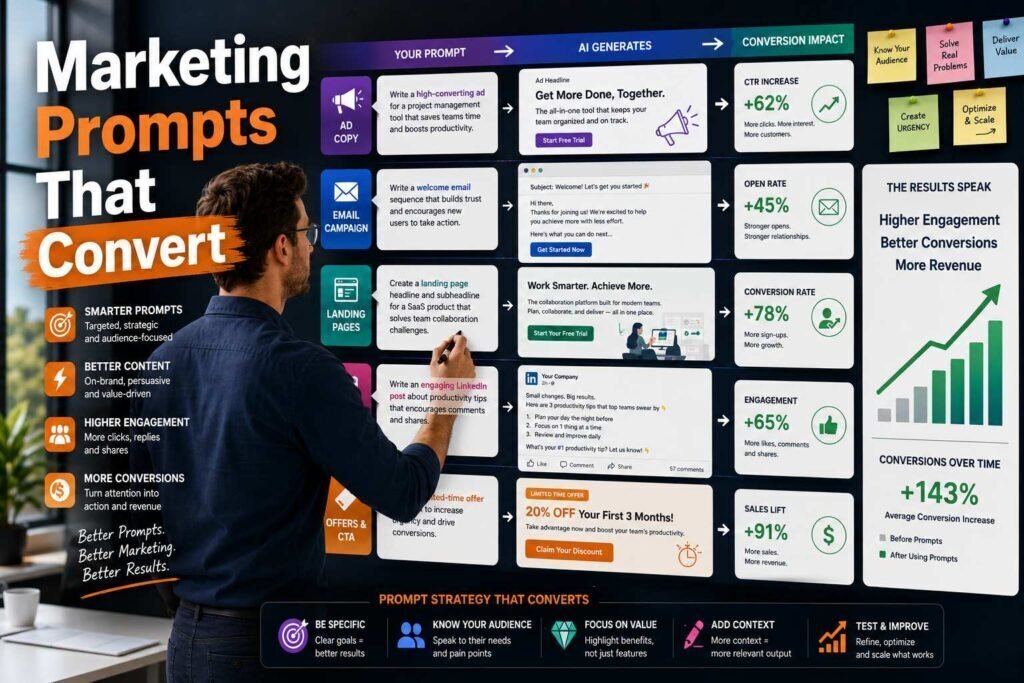
These marketing prompts produce usable output because they force you to supply what matters: audience, offer, and goal. Generic prompts give generic results, so every prompt here asks for specifics. Below you will find a quick method for briefing the AI, tested prompts by channel, and a short section on editing the output so it actually converts. Replace [variables] and always edit the output to add your real expertise. Pair with our AI marketing tools guide.
How to Use
- Fill every [variable] with real detail. Vague inputs produce forgettable output.
- Provide a brand-voice sample so output sounds like you, not like AI.
- Use AI for the first draft; add your data, examples, and opinions before publishing.
Start With a Brief and a Brand Voice
The single biggest lever on marketing output is the brief you give. Before any channel prompt, define three things: the audience (who they are and what they want), the offer (what you are promoting and why it matters), and the one goal for this piece. Then give the AI a brand-voice sample — two or three sentences of your best writing — and tell it to match the tone. Generic copy is almost always a symptom of a generic brief. Spend two minutes on these inputs and every prompt below produces something closer to publishable, because the model is working from your specifics instead of guessing.
Content Strategy and Blogging
SEO
Landing Pages and Conversion Copy
Customization tip: give it the offer, the audience, and the one action you want; conversion copy fails when it asks for too many things at once.
Social Media
Ads and PPC
Video and Short-Form Scripts
PR, Announcements, and Outreach
Partnerships and Influencer Briefs
Analytics and Reporting
Repurposing One Asset Into Ten
The highest-leverage marketing move is turning one strong piece into many. Create the core asset, then atomize it with a single prompt.
One well-researched article can feed a week of content this way, which keeps your channels consistent without starting from scratch each time.
Brand Voice and Positioning
Customer Retention and Lifecycle
Local and Small-Business Marketing
Worked Example: From Generic to Specific
The difference between forgettable and effective marketing copy is almost always the brief. Compare “write a promo email for our software” with “write a 120-word promo email to small-business owners for our bookkeeping tool; lead with the pain of month-end reconciliation, mention we automate it, one call to action to start a free trial, friendly-but-direct tone, no hype.” The first gives you a bland template; the second gives you something close to sendable, because it supplies the audience, the pain, the offer, the tone, and the single action. Every prompt in this library is built to pull those specifics out of you, and the output quality tracks directly with how much real detail you provide.
Editing AI Copy So It Converts
Raw AI output rarely converts as written, because its default is safe and generic. A short editing pass fixes that. Cut the throat-clearing opening and lead with the reader’s problem or desired outcome. Replace vague claims with specific proof: numbers, examples, and named results. Swap hype adjectives for concrete benefits, and read it aloud to catch the stiff, list-like rhythm models tend to produce. Make sure there is exactly one clear call to action, not three competing ones. Finally, check every factual statement, since a fabricated statistic or feature can quietly slip into otherwise clean copy. Five minutes of this turns a generic draft into something that sounds like your brand and earns the click.
A Simple Weekly Content Routine
The teams that get the most from AI do not use it randomly; they build it into a rhythm. A workable weekly loop looks like this: on Monday, generate ideas and briefs for the week from your keyword and audience notes; midweek, draft the one substantial asset that will anchor everything, whether an article, a landing page, or a newsletter; then atomize that asset into social posts, emails, and short scripts with a single repurposing prompt. Reserve a slot to edit everything against your brand voice and check any claims before it goes out. This turns AI from a novelty you open occasionally into a dependable part of your production line, where you stay the strategist and editor and the tool absorbs the drafting.
A Quick-Start Checklist
- Define voice once: build a brand-voice sample and paste it into every prompt.
- Brief first: audience, offer, and one goal before any copy.
- Create the core asset, then atomize it into emails, social posts, and scripts.
- Edit to convert: lead with the problem, add proof, keep one call to action.
- Verify claims before publishing.
Common Mistakes
- Publishing AI drafts unedited; add your data and voice or it reads generic.
- Skipping the brand-voice sample.
- Making claims you cannot back up; keep marketing honest and compliant.
- Asking for everything in one prompt instead of briefing, drafting, then editing.
FAQs
Will AI content hurt my SEO?
No, if it is edited, original, and genuinely useful. Mass-produced filler does. See our AI writing tools guide.
How do I keep AI copy from sounding like everyone else’s?
Feed it your brand voice, real customer language, and specific proof points. The default output is generic because the input was generic; specificity in equals specificity out.
Can AI do keyword research?
It is great for brainstorming topics and clustering keywords, but it does not have live search-volume data. Pair it with a real keyword tool for numbers, and use AI to turn those numbers into a plan.
Do these prompts work for local or small businesses?
Yes. Add your city, service area, and customer type, and ask for practical, low-budget tactics. Local specifics make the output far more useful than generic advice.
How do I measure whether AI is actually helping?
Track the outcomes you cared about before AI: publishing cadence, engagement, leads, and conversions, plus the time each task now takes. More good content in less time, without a quality drop, means it is working.
Which AI tools pair best with these prompts?
A strong general assistant handles most drafting, and you can add specialized tools for SEO data, design, or scheduling as you scale. See our roundup of AI tools for marketing teams to match tools to your workflow.
How do I get started if I am new to AI marketing?
Pick one channel and one repetitive task, such as drafting your weekly email or turning posts into social snippets, and use a single prompt from this library until it reliably works. Build from that one win rather than trying to automate everything at once.
Should I disclose that content is AI-assisted?
Follow your industry norms and any platform rules. Many teams keep an internal AI-assisted content policy and focus public disclosure on accuracy and editorial standards rather than tooling. What matters most to readers is that the content is correct and useful.
What is the biggest mistake marketers make with these prompts?
Accepting the first draft. The value is in iteration and editing: generate, add your proof and voice, then tighten. One well-edited asset beats ten unedited ones, and unedited output at scale is exactly what reads as generic AI content.
Keep Exploring
Combine these prompts with the right tools from our marketing stack guide. Prompts plus a workflow beat prompts alone.