
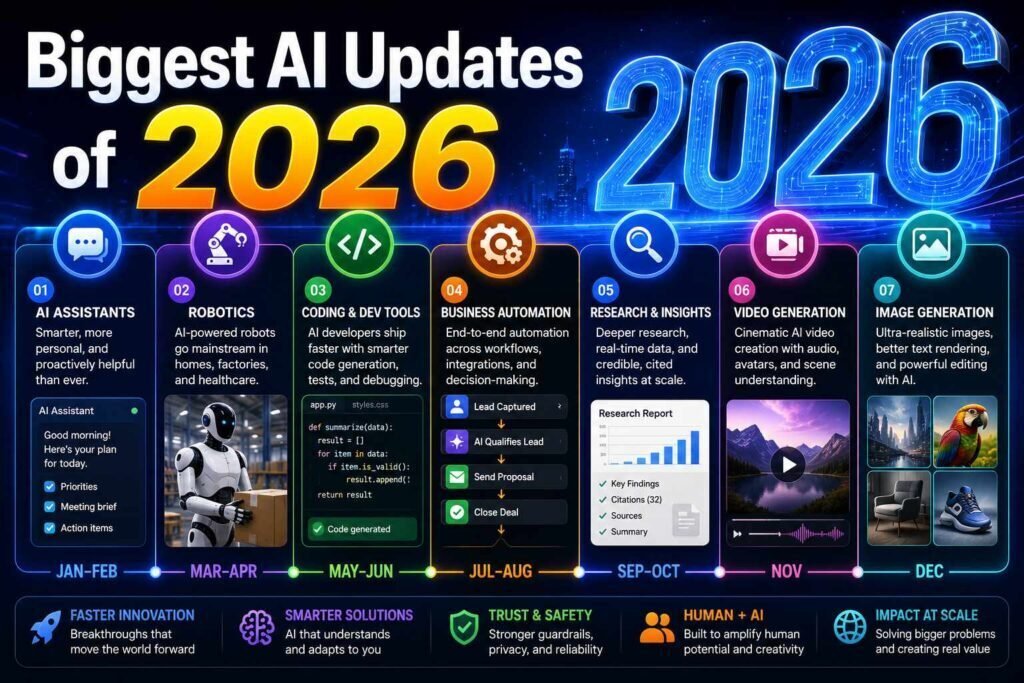
Most AI headlines are noise. A handful of shifts in 2026 genuinely change how people work. This guide covers those durable trends, not the daily churn, and translates each into what it means if you are a marketer, a developer, or running a business. For dated, breaking items see our Latest AI News hub.
Key Takeaways
- Agentic AI (tools that take multi-step actions, not just chat) is the defining shift of 2026.
- Longer context and native multimodality make AI useful on real documents, images, audio, and video.
- Competition keeps pushing capability up and prices down, with strong free tiers.
- AI is increasingly bundled into software you already pay for, changing the “should I buy a separate tool” math.
- Disclosure and data rules are tightening; businesses need clear AI usage policies.
The Five Shifts That Matter
| Shift | What it means | Who it affects most |
|---|---|---|
| Agentic AI | AI that plans and acts across steps and tools | Developers, operations, support |
| Longer context | Whole documents and codebases in one pass | Lawyers, researchers, developers |
| Native multimodal | Image, audio, and video as first-class inputs | Marketers, creators, analysts |
| Pricing and bundling | Cheaper, often free, and built into existing tools | Every business budgeting for tools |
| Regulation and trust | Disclosure rules, data controls, provenance | Legal, compliance, leadership |
1. Agentic AI Goes Mainstream
The biggest change is AI that does work, not just describes it: reading a repo and making changes, running a research task end to end, or handling a support ticket across systems. This moves AI from “smart autocomplete” to “junior teammate you review.” The catch is unchanged: agents need supervision, guardrails, and review, because an unreviewed autonomous action is a liability, not a feature.
Adopting Agents Without Getting Burned
Because agentic AI is the year’s defining shift, it deserves the most careful adoption, and a pattern has emerged among teams doing it well. Start with one process that is repetitive, bounded, and low-blast-radius, triaging inbound requests, drafting responses for review, running a defined research task, rather than anything customer-facing or irreversible. Define what the agent may do alone and where a human must approve, and instrument it so failures surface instead of hiding. Review its output the way you would a new hire’s for the first month, then loosen supervision only as earned. The teams reporting real gains all share this shape: narrow scope, explicit guardrails, human review at the consequential moments, and expansion only after the first process proves itself. The teams reporting horror stories skipped one of those four. The technology is genuinely ready for careful adopters, and genuinely dangerous for careless ones, which makes the discipline, not the model choice, the actual differentiator this year.
2. Longer Context and Native Multimodality
Models now handle very large inputs and accept images, audio, and video directly. In practice that means analyzing a full contract, a quarter of meeting recordings, or a folder of screenshots in one go. Capacity still outruns perfect comprehension, so verification of key details remains essential, as covered in our long-document comparison.
3. Cheaper, Freer, and Bundled In
Fierce competition keeps pushing capability up and prices down, with unusually generous free tiers (see our 100 free AI tools roundup). Just as important, AI is increasingly built into software you already pay for, CRMs, design tools, office suites, so the smart first question is no longer “which AI tool should I buy” but “what AI is already included in what I own?”
4. Regulation and Trust Tighten
Disclosure requirements, data-use rules, and content-provenance expectations are expanding. For businesses this means writing a clear AI usage policy, using business tiers with training disabled for sensitive data, and disclosing AI-generated content where required. Our AI-Assisted Content Policy is a working example of how a publisher handles this.
The Quiet Fifth Column: Open and Local Models
Running underneath the headline shifts is a trend that compounds them all: open-weight models you can run on your own hardware keep closing the gap with the frontier. For businesses, this changes the floor of every negotiation, capable AI now exists at zero subscription cost with total data privacy, which both disciplines vendor pricing and gives regulated industries a path to AI that never touches a third-party cloud. For developers, local models mean experimentation without metering and deployment without data exposure. The practical takeaway is not that everyone should switch to local models; hosted frontier tools remain more capable and far more convenient. It is that the open alternative now sets a real baseline: any subscription you pay for must beat “free, private, and good enough” by a margin that justifies its bill, and each year that margin gets examined more skeptically.
The Skills That Matter More This Year
Each shift quietly re-prices skills, and it is worth naming the winners. Specification, the ability to define a task precisely enough that an agent or assistant executes it correctly, is becoming the leverage skill across every role, replacing raw production speed. Review judgment, catching the subtle error in fluent output, grows more valuable as generation gets cheaper; the scarce ability is no longer producing a draft but knowing which draft is wrong. Verification habits, checking sources, testing code, confirming figures, separate professionals whose AI use compounds from those whose mistakes do. And tool judgment, knowing what your stack already includes and when a new tool genuinely earns a place, directly converts to budget. None of these require technical depth, all of them transfer across model generations, and every one of them appreciates while pure execution skills deflate. Aim your own learning, and your team’s, at those four.
What It Means for Marketers
- Multimodal tools speed up content and creative; the differentiator is your judgment and brand voice, not access to the tools everyone now has.
- Native AI inside ad and CRM platforms often beats separate point tools; see our marketing tools guide.
- Disclosure and authenticity matter more as AI content floods every channel.
What It Means for Developers
- Agentic coding tools change the job toward specification and review; see our AI coding tools guide.
- Longer context makes whole-codebase reasoning practical.
- Free and open models (run locally) make capable AI available without subscriptions or data exposure.
What It Means for Businesses
- Audit AI already bundled in your stack before buying more.
- Write an AI usage and data policy; train the team on it.
- Pilot agentic automation on one repetitive process with human review; see our automation tutorial.
- Revisit tool decisions quarterly, not weekly.
A Quarter-by-Quarter Adoption Plan
Translating five shifts into a year of deliberate action looks like this. First quarter: run the bundling audit, cancel overlapping AI subscriptions, and write the one-page usage policy covering what data may go where and who reviews AI output. Second quarter: pilot one agentic automation on a supervised, low-risk process, and measure hours saved honestly. Third quarter: extend what worked, bring long-document or multimodal workflows into the roles that need them, and train the team on the specification and review skills above. Fourth quarter: review the year’s changes against results, prune what did not earn its place, and set next year’s single biggest bet. Four quarters, four moves, each measured before the next begins. A business that follows this calendar ends the year transformed by exactly the shifts that mattered, having ignored everything that did not.
What Has Not Changed
A trends guide owes you the stable ground as much as the shifts. AI still fabricates confidently, so verification remains mandatory for anything that matters, no 2026 release changed that. Quality still comes from specific input: context, examples, and constraints in, quality out, exactly as before. Data discipline still rules: sensitive material belongs in business tiers with training disabled or on local models, and no capability gain repeals that. Human accountability has not moved: the professional who signs, ships, or files remains responsible regardless of what drafted it. And the fundamentals of good work, knowing your audience, your codebase, your clients, remain the multiplier on every tool. This stability is good news: the habits you built around earlier AI generations transfer intact, and the professionals doing best in 2026 are mostly running old disciplines on new capability.
Common Mistakes to Avoid
- Deploying agents without guardrails. Unreviewed autonomous action is a liability; scope narrow, review always, expand slowly.
- Buying separate AI tools before auditing bundles. The capability you want is increasingly inside software you already pay for.
- Confusing capacity with comprehension. Bigger context windows still miss mid-document details; verify the passages that matter.
- Postponing the AI usage policy. Disclosure and data rules are tightening; a one-page policy now beats a scramble later.
- Chasing every shift at once. One deliberate adoption per quarter, measured, beats five simultaneous pilots nobody reviews.
FAQs
Will AI replace jobs in 2026?
It is reshaping tasks faster than whole jobs, automating repetitive work and shifting people toward judgment, review, and relationships. Teams that adopt it deliberately tend to do more with the same headcount.
What is the single most important AI trend this year?
Agentic AI. Tools that take actions, not just answer questions, change workflows the most, and demand the most care.
How should a small business start?
Turn on the AI already in your tools, pick one repetitive process to automate with review, and give the team a general assistant with a clear data policy. That trio, bundled features, one supervised automation, one well-governed assistant, captures most of the year’s practical value at almost no cost, and everything further can build on what it teaches you.
Which of the five shifts should a small business act on first?
Pricing and bundling, because it is pure savings: audit what AI your current subscriptions already include, cancel the overlap, and fund anything genuinely new from what you reclaim. Agentic automation comes second, piloted on one supervised process. The others mature on their own schedule while you capture the easy value.
Do I need to understand the technology behind these trends?
No. Every shift here is actionable at the level of tools, policies, and workflows, which tier you buy, what you automate, what your team may paste where. Deeper technical understanding helps developers, but for most roles, judgment about use matters far more than knowledge of internals.
How fast do I actually need to move on any of this?
Slower than the coverage implies. These are year-scale shifts, not weekly emergencies; a business that adopts one carefully each quarter finishes the year genuinely modernized, while one that chases everything simultaneously mostly accumulates half-configured tools. The exception is the policy work, data rules and disclosure, where being early is simply cheaper than being late.
Will these trends hold, or could 2026 surprise us?
The direction of each shift is well established even though specific products and rankings will keep changing, which is why this guide avoids naming version numbers. Expect surprises in the details, which vendor leads, which feature ships first, and durability in the shape: more action-taking, more context, more bundling, more rules. Build your plans on the shape.
Where can I follow how these shifts develop through the year?
Our Latest AI News hub tracks dated developments against these trends, and This Week in AI is the five-minute weekly pass. Between them and a quarterly review of this guide, you can watch the year unfold without surrendering your attention to the daily churn.
Should I wait for the trends to settle before adopting anything?
No; the shifts in this guide are already shipping in tools you can use today, and the quarterly plan above is deliberately conservative. Waiting for a fast-moving field to settle means waiting forever. Adopt carefully and incrementally, and let measured results, not perfect certainty, drive the pace.
Bottom Line
The 2026 story is AI that acts, understands more at once, costs less, and comes built in, inside a tightening trust and regulation environment. Ignore the daily hype, act on these five durable shifts, and revisit your toolset on a quarterly cadence. Subscribe to the AdNxt newsletter to track what changes next.
Related Articles
Sources: official announcements and documentation, checked early 2026. Verify specific product claims and add dated examples before publishing; label any speculation.