
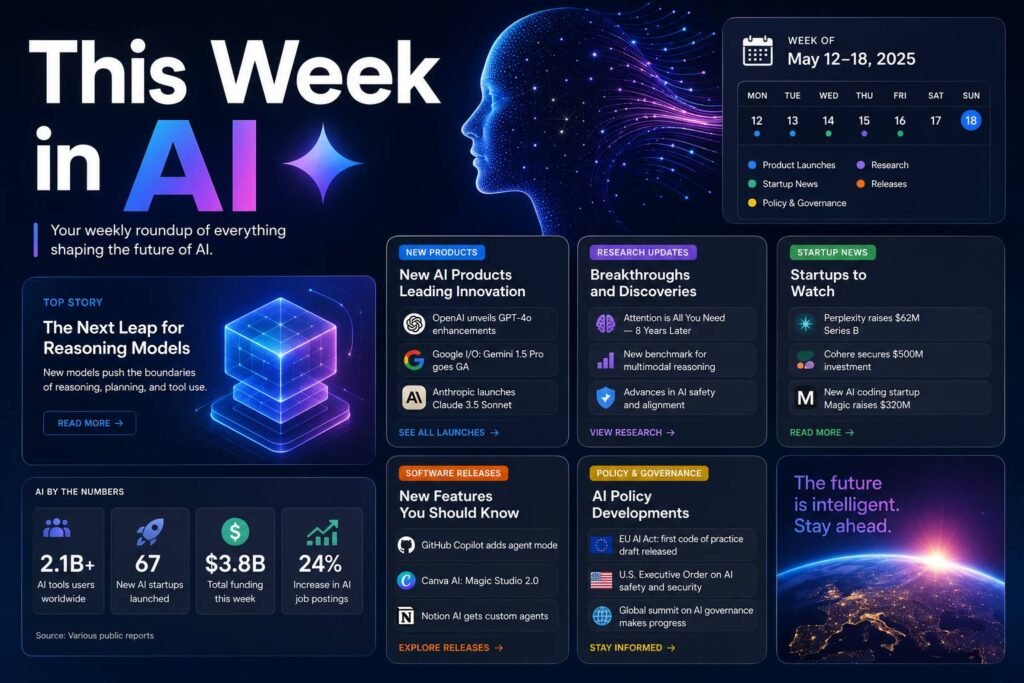
Week of: [SET THE WEEK/DATE].
A five-minute read on what actually happened in AI this week, and whether it matters to your work. We skip the hype and the vaporware. Every item links its source.
This Week at a Glance
- [One-line summary of the single biggest item.]
- [One-line summary of a notable tool or feature.]
- [One-line summary of an industry or pricing change.]
How This Weekly Digest Works
Every week we sweep the announcements, changelogs, and reporting across the AI industry, then apply one filter: does this change what a working professional should try, watch, or budget for? What survives lands in the four sections below, new tools, feature updates, industry and pricing changes, and regulation and safety, each item with its original source linked so you can verify rather than trust. What does not survive is the majority: staged demos, benchmark skirmishes, funding announcements, and roadmap promises that have not shipped. The result is deliberately short. If a week was quiet, the digest says so instead of inflating minor items, because the promise of this page is that five minutes here genuinely covers the week, and that discipline only works if we respect it when there is little to report.
New Tools
[EDITOR: List genuinely new, notable tools this week. For each: name, what it does, who it is for, a source link, and one honest line on whether it is worth trying yet. Remove unverified entries.]
How to read this section: a new tool earns a spot here by doing a real job meaningfully better, cheaper, or more simply than what exists, not by being novel. When you see an entry, judge it the way we do: who is it actually for, what does it replace in a real stack, and is it shipped and usable today rather than waitlisted? Our honest one-line verdict tells you whether it is worth ten minutes now; most new tools are worth a bookmark at best until a second version proves the maker is serious.
Feature Updates
[EDITOR: Meaningful updates to tools people already use. Prioritize features that change how work gets done, not cosmetic changes. Link each source.]
How to read this section: feature updates to tools you already use are quietly the highest-value news category, because capability arrives with zero migration cost. We prioritize changes that alter how work gets done, a real automation, a meaningful model upgrade, a workflow that collapses steps, over cosmetic refreshes. When your own tools appear here, that is your cue to spend five minutes in the changelog; bundled features you already pay for beat new subscriptions almost every time.
Industry and Pricing Changes
[EDITOR: Acquisitions, pricing shifts, free-tier changes, partnerships, notable outages or incidents. Separate confirmed facts from rumor.]
How to read this section: money news, pricing shifts, free-tier changes, acquisitions, and notable incidents, is where AI headlines most directly touch your budget and your risk. Price changes on tools you pay for deserve immediate attention; acquisitions matter mainly for what they signal about a tool’s future support; incidents and outages matter if your data or workflows were in the blast radius. We separate confirmed facts from rumor explicitly, because this category attracts the most speculation.
Regulation and Safety
[EDITOR: New rules, disclosure requirements, or safety developments relevant to businesses. Link primary sources.]
How to read this section: regulation moves slower than the rest of AI but carries obligations the other sections do not. We include developments that plausibly affect how businesses must disclose, protect data, or restrict AI use, always linked to primary sources, because secondhand summaries of legal text age badly. Treat entries here as prompts to check whether a rule applies to your jurisdiction and sector, and consult a professional for anything that looks binding rather than relying on any digest, including ours.
What to Actually Do This Week
- Try: [the one thing worth ten minutes of your time this week, if any].
- Watch: [something developing that is not ready for action yet].
- Ignore: [the overhyped item you can safely skip].
The Ten-Minute Tool Trial
When the digest flags something as worth trying, here is how to make ten minutes count. Skip the tour and the sample data; bring one real task from your actual week, the email you need to write, the data you need to summarized, the image you need produced, and run it through the tool immediately. Judge three things: did the output need less fixing than your current method, did the workflow feel like something you would reach for under deadline, and did anything about the data handling give you pause? One real task answers more than an hour of feature exploration, because tools that demo well and work badly fail exactly at the contact point with real work. If the trial impresses, schedule a second session with a different task before subscribing to anything; if it does not, close the tab without guilt. The digest will bring another candidate next week.
Why Weekly Is the Right Cadence
Daily AI coverage overwhelms and under-informs: the signal-to-noise ratio of any single day is poor, stories reverse themselves within hours, and the compulsion to check becomes its own productivity tax. Monthly, at the other end, is too slow for a field where pricing, features, and free tiers genuinely move. Weekly is the deliberate middle: long enough for the week’s noise to settle into a few items with substance, short enough that nothing urgent, a price change, a security issue, a deprecation, reaches you late. It also matches how work actually absorbs change: one trial, one watch item, and one thing to ignore per week is a sustainable rhythm that compounds, while anything faster produces the tool-churn that costs teams more than it teaches. Five focused minutes a week, protected by someone else’s filtering, is the most efficient relationship with AI news available.
Making the Digest Work for You
The try-watch-ignore structure above is designed to be acted on in minutes, and a small routine captures the value. Give the “try” item its ten minutes this week, on a real task rather than a toy, and keep it only if it earns a place. Put “watch” items on a list you revisit monthly instead of tracking daily, since developing stories resolve on their own schedule. And take the “ignore” permission seriously; it exists because attention is the actual scarce resource in AI news. Readers who follow this pattern make one or two deliberate stack improvements a quarter, which compounds into a genuinely modern toolkit, while spending less time on AI news than anyone else in the room. That trade, small consistent attention for compounding capability, is the entire point of a weekly digest.
Using Past Editions as a Research Tool
A weekly digest accumulates into something more useful than any single edition: a dated record of when capabilities actually arrived, priced, shipped, and verified, which is surprisingly hard to reconstruct later from marketing pages. When you are evaluating a tool, skimming its past digest mentions shows whether the maker ships consistently or announces loudly and delivers rarely, which is the single best predictor of whether to depend on them. When budgeting, the pricing-change trail shows which vendors raise quietly and which hold stable. And when a colleague claims “everyone is using X now,” the record shows when X actually became usable, which is frequently much more recent, or much less true, than the claim. Treat the archive as evidence, and the weekly five minutes compounds into institutional memory about a fast-moving field.
Staying Sane in a Fast-Moving Field
A note on the anxiety that AI news uniquely produces. The feeling that everything is changing weekly and you are perpetually behind is manufactured partly by coverage incentives, and the antidote is noticing what actually changes at what speed. Fundamentals move slowly: the prompting skills, verification habits, and workflow discipline that make AI useful have been stable for years and transfer across every model generation. Capabilities move quarterly: models genuinely improve, features genuinely ship, and a quarterly review catches all of it. Only the discourse moves daily, and it is the one layer you can safely ignore. If you are using a capable assistant well, trying one flagged tool a week, and reviewing your stack quarterly, you are not behind; you are ahead of the overwhelming majority of professionals, including many who read AI news all day. The digest exists so that staying current costs minutes, not peace of mind.
What We Deliberately Leave Out
Knowing what a digest excludes tells you what its inclusion means. We leave out funding rounds unless they change a product’s pricing or survival odds, because valuations are investor news, not user news. We leave out benchmark disputes, since our standard is your work, not leaderboards. We leave out drama between AI companies and personalities, however entertaining, because it has never once changed what a reader should do on Monday. We leave out research papers until their results ship in products you can touch. And we leave out anything we could not verify against a primary source by press time, which some weeks means a story you saw elsewhere is absent here on purpose. When an item does appear in this digest, it has cleared all five filters, which is precisely what makes five minutes here worth more than an hour of feed.
Common Mistakes to Avoid
- Trying everything. One real trial a week beats five shallow ones; the digest names its single best candidate for a reason.
- Skipping your own tools’ updates. The feature-update section is where free capability appears; read it even on busy weeks.
- Treating rumors as facts. We label the difference; act only on the confirmed side.
- Letting the watch list become a to-do list. Watching means waiting; revisit monthly and let items resolve.
- Reading multiple digests covering the same week. Pick one you trust and spend the saved time actually trying something.
FAQs
How do you decide what makes the roundup?
Impact on real work, not press-release volume. We favor shipped features over announcements and always link the source.
Where can I get this in my inbox?
Subscribe to the AdNxt newsletter for the weekly digest.
Who is this digest written for?
Working professionals and small-business owners who use AI tools but do not want following the field to become a second job. Developers and researchers may want deeper sources alongside it; for everyone else, this plus a quarterly stack review is genuinely enough to stay current.
How does the try-watch-ignore verdict get decided?
By asking what a busy reader should do, not what is most impressive. “Try” goes to the shipped item with the best effort-to-payoff ratio this week, “watch” to developing stories where acting now would be premature, and “ignore” to whatever is consuming the most attention relative to its practical value, which some weeks is the biggest headline of all.
Why is some weeks’ digest so short?
Because some weeks are genuinely quiet, and padding them with minor items would break the five-minute promise. A short edition is a feature: it means you can get back to work with a clear conscience, knowing nothing significant slipped past.
What is the difference between this and the Latest AI News hub?
This is the quick weekly pass; the news hub is the running record with deeper evaluation frameworks. If you only have five minutes, read this; if a specific update might change your tools or compliance, the hub is where we work through it.
Do you cover rumors and leaks?
Sparingly, always labeled as unconfirmed, and only when preparing for the possibility has practical value. Shipped software is the standard; the industry’s rumor mill is entertaining, but it has a poor record of predicting what actually arrives and when.
Can I suggest an item for the roundup?
Yes, through our contact page, with a link to the primary source. The bar is the same as for everything else here: shipped, verifiable, and relevant to real work. Genuinely useful finds from readers make the digest better for everyone.
Bottom Line
Most weeks bring one or two updates worth your attention and a lot worth ignoring. We do the sorting so you can spend five minutes here and get back to work. For the bigger picture, see our 2026 AI updates guide.