
Disclosure: This comparison is published by Dubb, one of the two tools below. We have worked to compare both fairly, including where Loom is the better choice. Pricing and features were verified on each company’s official site in early 2026; confirm current details before deciding.
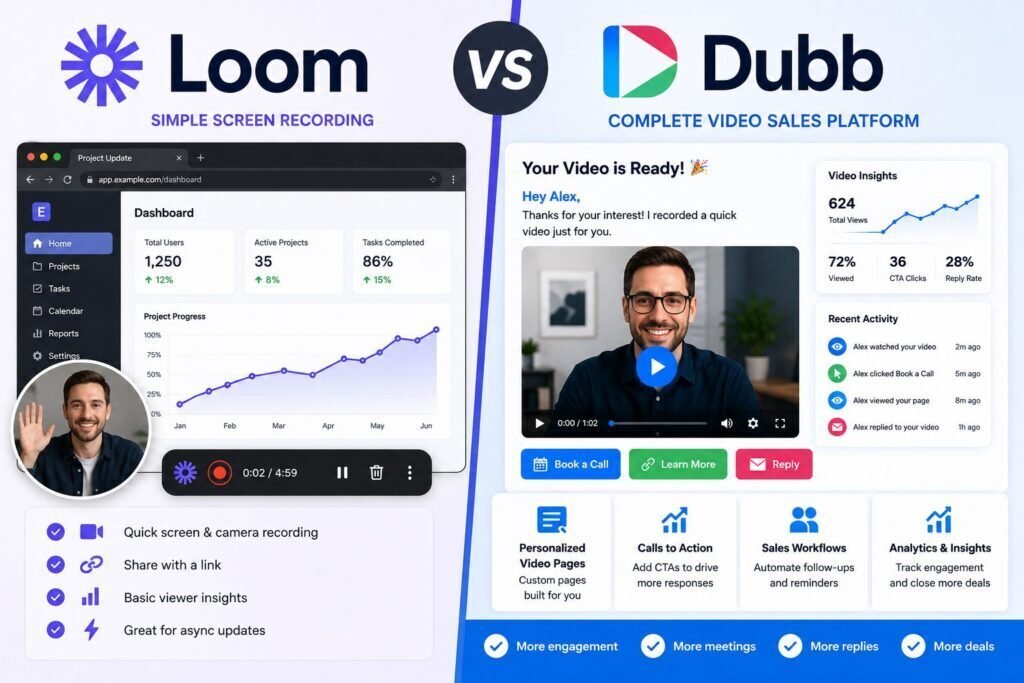
Loom and Dubb both let you record a video and share it with a link, but they are built for different jobs. Loom is one of the most popular screen-recording and async video tools, loved for effortless recording and team communication. Dubb is a sales-focused video platform built around converting views into meetings, with video email, landing pages, calls to action, and tracking. If you are choosing for sales specifically, the difference matters. This guide compares them fairly.
Quick verdict: Choose Loom if your main need is quick screen recordings, async team communication, and simple sharing, especially inside a company. Choose Dubb if your goal is sales: video email, personalized landing pages, calls to action, and tracking that turns views into booked meetings. Loom is the better all-purpose recorder; Dubb is the better sales-conversion tool.
Key Takeaways
- Loom excels at quick screen recording and async team communication, with huge adoption.
- Dubb is built for sales: video email, landing pages, CTAs, and conversion tracking.
- Both offer free plans; Loom’s free tier caps videos and recording length.
- Loom Business starts around $18 per user per month; Dubb Pro around $59 per month (verify).
- Pick Loom for internal and general recording; pick Dubb for a sales-conversion workflow.
Loom vs Dubb at a Glance
| Dimension | Loom | Dubb |
|---|---|---|
| Core focus | Screen recording and async team video | Sales video and conversion |
| Best for | Internal comms, quick recordings | Outreach, follow-up, booking meetings |
| Free plan | Yes (25 videos/person, 5-min cap, 720p) | Yes (Starter) |
| Entry paid price | Business from about $18/user/mo (verify) | Pro from about $59/mo (verify) |
| Video email workflow | Basic sharing | Built-in, with thumbnails and tracking |
| Landing pages and CTAs | Limited | Yes, with custom CTAs |
| Video SMS | No | Yes |
| Sales automation | Limited | Campaigns and automation (higher tiers) |
| AI | AI editing, summaries, transcripts | AI Productivity Suite, Sales Agent |
Verified early 2026; confirm current pricing and features on each site.
Recording: Loom’s Strength
Loom is exceptional at the core act of recording. It makes capturing your screen, camera, or both effortless, with instant share links, and it is used across hundreds of thousands of companies. Its free plan lets you record up to 25 videos per person with a five-minute cap and 720p quality, and paid plans unlock unlimited videos, longer recordings, and 4K. Loom also offers strong AI features like automatic titles, summaries, and transcripts in many languages. For quickly explaining something on your screen and sharing it, Loom is hard to beat, and that simplicity is why it is so widely adopted.
Sales Workflow: Dubb’s Strength
Dubb records video too, but its focus is what happens after the recording. It is built to convert: video email with clickable thumbnails, hosted landing pages, customizable calls to action, video SMS, campaigns, automation, and engagement tracking aimed at booking meetings. Where Loom gives you a video and a share link, Dubb gives you a branded page with a booking button, tracks who watched, and fits into a sales sequence. For an SDR or AE running outreach and follow-up, that conversion-focused workflow is the difference between a video that gets watched and a video that books a meeting.
Video Email and Sending
This is a clear divide. Dubb is built around video email as a sales motion, inserting a clickable thumbnail into your Gmail or Outlook message and tracking engagement, plus supporting video SMS and LinkedIn sharing. Loom lets you share a link, which you can paste into an email, but it is not designed as a sales video-email workflow with thumbnails, pages, and CTAs in the same way. If sending trackable video email to prospects is central to your work, Dubb is purpose-built for it.
Landing Pages, CTAs, and Conversion
Dubb creates a hosted landing page for each video with your branding and a call-to-action button, such as a booking link, so an interested viewer can act immediately. Loom’s sharing is more about viewing the video than converting the viewer, with limited CTA and landing-page capabilities by comparison. For sales, the CTA and page are what turn interest into a meeting, which is why Dubb builds its workflow around them. Our guide to video CTAs explains why this matters.
Analytics
Both offer engagement analytics, but with different emphasis. Loom shows view data useful for knowing whether your team or audience watched. Dubb frames analytics around sales follow-up: who watched, how far, and whether they clicked your CTA, so you can prioritize outreach. If you need engagement data to drive a sales process, Dubb’s approach fits; if you mainly want to know a recording was seen, Loom’s is sufficient.
Pricing Compared
Both start free. Loom’s free Starter plan caps you at 25 videos per person, five-minute recordings, and 720p, with Business at around $18 per user per month, Business + AI around $24 per user per month, and custom Enterprise (which adds SSO and a Salesforce integration). Dubb offers a free Starter plan, with Pro from around $59 per month, Pro Plus around $129 per month, custom Enterprise, and the Sales Agent AI add-on around $50 per month. Loom’s per-user pricing is lower at the entry point, reflecting its lighter, recording-focused scope, while Dubb’s pricing reflects a broader sales toolkit. Compare based on what you need, and verify current pricing on both sites.
Who Should Choose Loom
- Teams that mainly need quick screen recordings and async communication.
- Companies using video internally for updates, feedback, and reducing meetings.
- Individuals who want the simplest possible recording and sharing.
- Anyone who values Loom’s low entry price and huge adoption.
Who Should Choose Dubb
- Sales teams that want to turn video views into booked meetings.
- Anyone who needs video email, landing pages, CTAs, and tracking in one place.
- Teams running outreach and follow-up sequences with video.
- Users who want video SMS and sales automation alongside email.
Can You Use Both?
Yes, and some teams do. Loom can handle internal recordings and quick explainers while Dubb powers external, sales-focused outreach. If your recording needs and your sales needs are distinct, running both is reasonable. But if you want one tool for sales video, choose based on whether your priority is effortless recording (Loom) or a conversion workflow (Dubb), since paying for two overlapping tools is only worth it when each has a clear, separate job.
Limitations to Weigh
Loom’s simplicity is also its limit for sales: it lacks the video-email workflow, landing pages, CTAs, SMS, and sales automation that a dedicated sales video tool provides. Dubb’s breadth means more to learn, and some features sit on higher tiers. Be honest about your primary use case, because the “better” tool here depends entirely on whether you are recording to inform or recording to sell.
The Internal Versus External Divide
One useful way to frame this choice is internal versus external communication. Loom rose to prominence as an internal tool: explaining work to colleagues, giving feedback, recording walkthroughs, and reducing meetings inside a company. It is superb at that, and its huge adoption reflects how well it serves async team communication. Dubb, by contrast, is oriented toward external communication with prospects and customers, where the goal is not just to inform but to persuade and convert.
That distinction explains most of the feature differences. Loom does not need landing pages, video SMS, or sales automation, because those are external, conversion-focused features. Dubb builds its whole workflow around them, because turning an external viewer into a booked meeting is the job. When you frame your decision as “am I mostly communicating internally or selling externally,” the right tool usually becomes obvious. Many organizations even use both, with Loom for internal video and Dubb for sales outreach, precisely because the two jobs are genuinely different.
Adoption, Ecosystem, and Support
Loom’s enormous user base is a real advantage in some ways: many people already know how to use it, it is widely trusted, and its recording experience is polished from years of refinement. If your team already uses Loom internally, adding it for light external use has almost no learning curve. Dubb’s ecosystem is more sales-specific, so its value shows up most for teams that adopt its conversion features rather than just its recording. Consider what your team already uses and what you are trying to achieve. If you want to extend an existing internal-recording habit, Loom is frictionless; if you want to build a dedicated sales video motion, Dubb gives you the tools that habit needs.
Which Should a Sales Team Standardize On?
For a sales team choosing one primary tool, the deciding question is whether your videos are meant to book meetings. If yes, standardize on Dubb, because its video email, landing pages, CTAs, and tracking are built for exactly that, and a recorder without those features will leave results on the table. If your team’s video use is mostly internal or explanatory, with selling being a minor use case, Loom’s simplicity and low cost make it a reasonable standard. Some teams land on a hybrid: Loom company-wide for internal video, Dubb for the sales org. Whatever you choose, base it on your dominant use case and confirm the current features and pricing on both sites before committing.
Frequently Asked Questions
Is Loom good for sales?
Loom is great for recording, and you can use it in sales, but it lacks the video-email workflow, landing pages, CTAs, and sales tracking of a dedicated sales tool like Dubb. For a full sales-conversion workflow, Dubb is purpose-built; for quick recordings, Loom shines.
Which is cheaper, Loom or Dubb?
Loom’s entry paid plan (around $18 per user per month) is lower than Dubb’s Pro (around $59 per month), reflecting Loom’s lighter scope. Both offer free plans. Compare based on the features you need, and verify current pricing.
Does Loom have landing pages and CTAs like Dubb?
Loom focuses on recording and sharing rather than sales landing pages and CTAs. Dubb builds a branded landing page with a call-to-action button for each video. Verify current features on both sites.
Can I send video emails with Loom?
You can share a Loom link in an email, but Loom is not designed as a sales video-email workflow with clickable thumbnails, pages, and tracking the way Dubb is. See our guide to video email with Dubb.
A Note on Value, Not Just Price
It is easy to compare the sticker prices, Loom’s lower per-user entry against Dubb’s higher plan price, and conclude Loom is the cheaper option. But price and value are not the same. Loom’s lower price reflects a narrower, recording-focused scope, while Dubb’s price includes the video email, landing pages, CTAs, SMS, automation, and sales tracking that a conversion workflow requires. For a sales team, paying less for a tool that does not book meetings is not a saving; it is a smaller investment with a smaller return. The right way to compare value is to ask what each tool helps you accomplish. If Loom’s recordings serve your goal, its price is great value. If your goal is booking meetings, judge Dubb by the meetings a full sales workflow can generate, not by its plan price alone. Match the spend to the job, and the better value becomes clear.
Verdict
Loom and Dubb are both excellent, but for different jobs. Loom is the better all-purpose recorder, ideal for quick screen recordings and async team communication, with a low entry price and effortless sharing. Dubb is the better sales tool, built to convert views into meetings with video email, landing pages, CTAs, SMS, and tracking. If your priority is recording, choose Loom; if your priority is selling with video, choose Dubb. Try Dubb’s free plan alongside Loom and see which fits your real workflow.
Want a video tool built to book meetings? Start free with Dubb and see the difference for sales.