
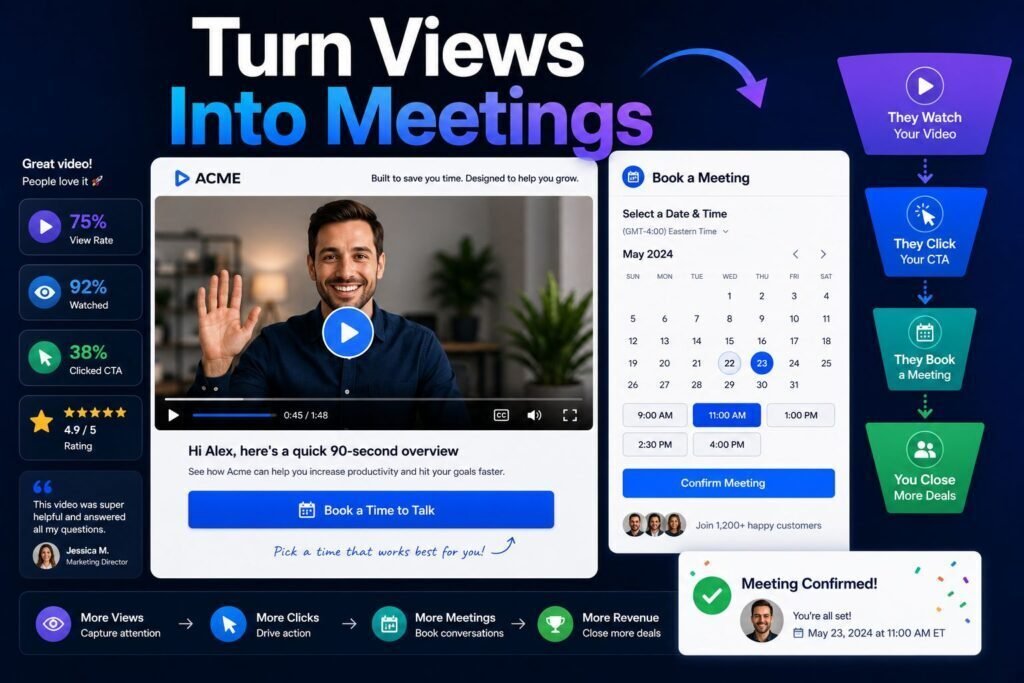
A view is not a win. Plenty of sales videos get watched and then lead nowhere, because the viewer finished the video and had no obvious next step to take. The call to action, or CTA, is what turns a passive view into a booked meeting or a reply. This guide shows you how to build video CTAs that convert, from what you say on camera to the button on the page.
Quick answer: Give every video exactly one clear call to action. Say it out loud near the end of the video, and reinforce it with a visible button or link on the page. Make the next step as low-friction as possible, such as a one-click booking link or a simple reply, and match the ask to where the prospect is in your funnel.
Key Takeaways
- One video, one CTA. Multiple asks create hesitation and lower response.
- Deliver the CTA both verbally in the video and visually on the page.
- Lower friction converts better: a one-click booking link beats “let me know your availability.”
- Match the ask to the funnel stage, from a simple reply early to a booked call later.
- Place the CTA where attention is highest and make it impossible to miss.
What Is a Video CTA?
A video CTA is the specific action you want the viewer to take after watching. It might be booking a meeting, replying to your email, watching a follow-up video, or starting a trial. Without one, even an engaged viewer is left thinking “that was interesting” and then closing the tab. The CTA gives that interest somewhere to go.
Strong video CTAs work on two levels at once. There is the verbal CTA, what you say near the end of the video, and the visual CTA, the button or link the viewer can click on the page. The best videos use both so the ask is clear whether the prospect is listening, watching, or skimming.
The One-CTA Rule
The most common CTA mistake is asking for too much. When you end a video with “you could book a call, or reply, or check out our site, or download this guide,” you hand the viewer a decision they did not ask for. Faced with several options, most people choose the easiest one: doing nothing.
One video, one CTA. Decide the single most valuable next step for this specific prospect at this specific moment, and ask for only that. A focused ask is easier to act on, and action is the whole point. If you genuinely have two things to offer, send two videos.
Types of Video CTAs
Different moments call for different asks. Here are the most useful ones, roughly from lowest to highest commitment.
| CTA | Best for | Example |
|---|---|---|
| Reply | Cold outreach, low friction | “Reply with a yes and I will send details” |
| Book a time | Warm prospects ready to talk | “Grab a 15-minute slot below” |
| Watch next | Guiding a nurture sequence | “Here is a 2-minute demo to watch next” |
| Start a trial | Product-ready prospects | “Start free and I will help you set up” |
| Answer a question | Re-engaging quiet deals | “Just tell me: still a priority this quarter?” |
The Verbal CTA: What to Say on Camera
The strongest place to deliver your CTA is with your own voice, near the end of the video. Spoken asks feel personal and direct, and they prime the viewer to notice the button below.
Keep the verbal CTA simple and confident. Say exactly what you want them to do and make it sound easy. “If this is useful, just reply and I will send a couple of times” works better than a long, hedged request. Avoid trailing off or stacking conditions. State the ask, then stop. A confident close signals confidence in your offer.
The On-Page CTA: Make It Impossible to Miss
Because your video lives on a hosted page, that page should carry a clear visual CTA too. A single, obvious button directly below the video, such as “Book a time” or “Reply to this,” catches the viewer at the exact moment their interest peaks, right as the video ends.
Keep the page focused. One button, not a menu of links. Remove navigation and distractions that pull attention away from the action you want. Many video platforms let you add a custom button and even personalize the page with the prospect’s name. A tool like Dubb builds these CTA-ready landing pages automatically, which is a big part of what separates a sales video from a plain hosted clip. See the category in our best video messaging software guide.
Placement and Timing
Where and when your CTA appears changes how well it works.
- End the video with the ask. The natural moment to act is right after you have delivered value, so put the verbal CTA in the final seconds.
- Keep the button visible throughout. On the page, the CTA button can stay in view the whole time, so a convinced viewer never has to hunt for it.
- Do not bury it. If a viewer has to scroll or search for the next step, many will not bother. Put it front and center.
Lower the Friction
Every bit of effort you ask for costs you conversions. The lower the friction, the more people act.
Compare “let me know your availability and we can find a time” with “grab a slot on my calendar here.” The first makes the prospect think, propose times, and wait for your reply. The second is one click. A booking link that shows your real availability removes the back-and-forth entirely. Similarly, “reply with a yes” is easier than “fill out this form.” Whenever you can replace effort with a single click or a one-word reply, do it.
Match the CTA to the Funnel Stage
Asking for too much too early kills momentum. Scale the commitment to the relationship.
| Stage | Right-sized CTA |
|---|---|
| Cold outreach | A simple reply, not a 30-minute call |
| Warm follow-up | Book a short call |
| Post-demo | Confirm the next step you agreed on |
| Proposal | A decision call or a specific question |
| Renewal | Quick check-in or expansion conversation |
A cold prospect who barely knows you will not book a long meeting, but they might reply to a low-key question. Earn the bigger asks as the relationship warms.
Example CTA Scripts
Adapt these closing lines to your voice.
- Cold: “If this is worth exploring, just reply with a yes and I will send a couple of times.”
- Warm: “Grab whatever slot works for you on the link below, and we will dig in.”
- Proposal: “Take a look, and let us find 20 minutes this week to finalize it. Times are below.”
- Re-engagement: “No pressure at all, just reply and tell me if this is still on your radar.”
Each one names a single action and makes it easy. Pair them with the video types in our recording guide.
Measuring CTA Performance
Your CTA is only as good as the actions it drives, so measure it. Track how many viewers click the button or reply after watching, not just how many watch. If watch rates are high but CTA clicks are low, the problem is your ask: it may be unclear, too big, or poorly placed. Test different CTAs, one at a time, and keep the ones that convert. Our video sales metrics guide shows how to read these numbers.
Common Mistakes to Avoid
- No CTA at all. An engaged viewer with no next step does nothing.
- Too many CTAs. Multiple asks create hesitation. Pick one.
- High-friction asks. “Let me know your availability” loses to a one-click booking link.
- Hiding the CTA. If people have to hunt for it, they will not use it.
- Mismatched commitment. Do not ask a cold prospect for a long meeting.
Reduce No-Shows After the CTA
Booking the meeting is only half the win. A meeting the prospect forgets about is nearly as bad as no meeting at all. A few habits protect the meetings your CTA earns.
- Confirm with a quick video. A short “looking forward to it” video after they book adds a human touch and makes the meeting feel real.
- Send a reminder. A simple reminder the day before, with the value they will get, keeps the meeting top of mind.
- Make rescheduling easy. Life happens. An easy path to pick a new time recovers meetings that would otherwise vanish.
- Restate the value. Remind them what they will walk away with, so the meeting feels worth keeping.
The goal is to carry the momentum from the CTA all the way to a real conversation, not lose it in the gap between booking and meeting.
CTAs Beyond the Meeting
Not every video should ask for a meeting, and forcing that ask everywhere feels pushy. Sometimes the best next step is smaller. A nurture video might simply invite the viewer to watch a short demo next. A re-engagement video might just ask whether a project is still a priority. An onboarding video might point a new customer to a specific setup step.
Matching the ask to the moment keeps your outreach helpful rather than salesy. A well-timed small ask often builds more trust than a premature big one, and trust is what eventually earns the meeting anyway.
Test Your CTAs
Like everything in outreach, the best CTA is the one your data proves. Test one variable at a time. Compare a reply request against a booking link. Compare a CTA stated only in the video against one reinforced with an on-page button. Compare different wording for the same ask. Give each version a fair sample, keep the winners, and retire the rest. Small improvements to your CTA lift the conversion of every video you send, so this is time well spent.
Frequently Asked Questions
Where should I put the CTA in a sales video?
Deliver the spoken CTA in the final seconds, right after the value, and keep a visible button on the page throughout so a convinced viewer can act at any point.
Should I have more than one CTA?
No. One video, one CTA. Multiple asks split attention and reduce action. If you have two goals, send two videos.
What is the best CTA for cold outreach?
A low-friction one, usually a simple reply or a single question. Save booking links and bigger commitments for warmer prospects.
How do I make booking a meeting easier?
Use a scheduling link that shows your real availability so the prospect can pick a time in one click, with no back-and-forth email.
Align the CTA With the Whole Message
A CTA does not work in isolation. It should be the natural conclusion of everything that came before it. If your video builds a case for solving a specific problem, the ask should be to talk about solving that problem, not something unrelated. When the value you deliver and the action you request point in the same direction, the CTA feels obvious rather than pushy.
Before you record, decide the one action first, then build the message to lead there. This reverse approach keeps your video focused and makes the close feel earned. A viewer who nods along with your points and then hears an ask that fits them perfectly is far more likely to act than one who is surprised by a request that does not match the conversation.
Conclusion
Views only matter when they turn into conversations, and the CTA is what makes that happen. Give every video one clear ask, deliver it both out loud and on the page, lower the friction to a single click or a one-word reply, and size the commitment to the funnel stage. Add a clear, low-friction CTA to your next sales video and watch how many more views become replies. Then test one small change to that CTA next week, because steady improvement to your ask lifts the return on every video you will ever send.
Want CTA buttons and personalized landing pages built into every video? Try Dubb free and turn your views into booked meetings.