
Disclosure: This comparison is published by Dubb, one of the two platforms below. We have worked to compare both fairly, including where Vidyard is the better choice. Pricing and features were verified on each company’s official site in early 2026; confirm current details before deciding.
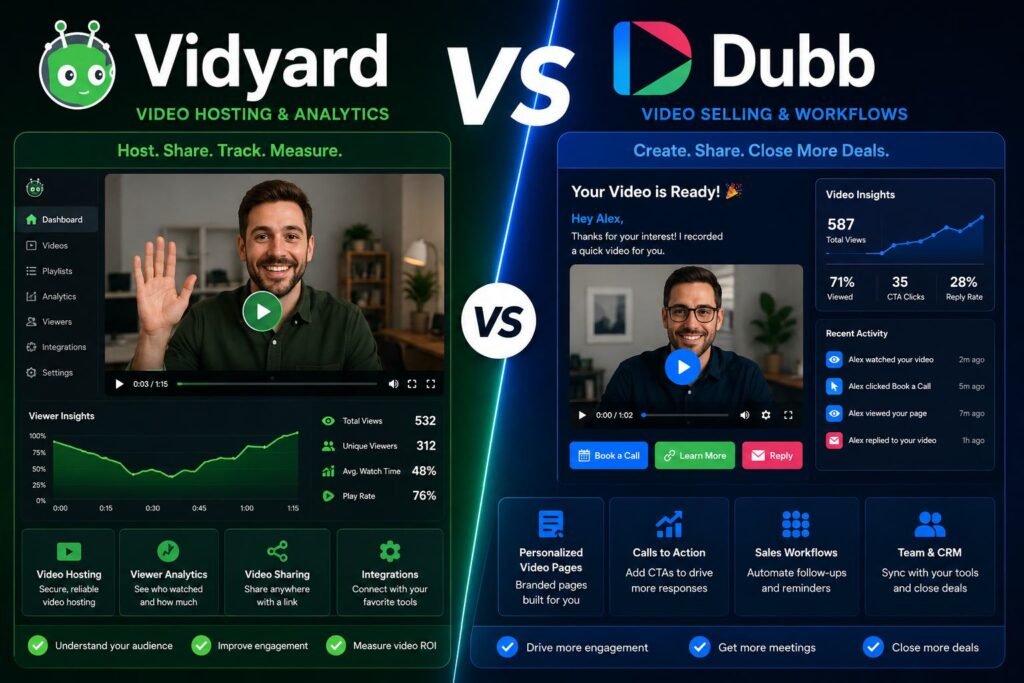
Vidyard and Dubb are both video platforms built for revenue teams, letting you record, send, and track sales videos. Vidyard is an established platform serving sales and marketing across company sizes, with a strong push into AI video and enterprise features. Dubb is an all-in-one sales video platform focused on the complete conversion workflow, with a generous free plan. This guide compares their features, pricing, and best use cases fairly.
Quick verdict: Choose Vidyard if you are a larger sales or marketing organization that wants deep AI video features like AI avatars and a Video Agent, extensive integrations, and enterprise scale. Choose Dubb if you want an all-in-one sales video workflow with landing pages, CTAs, SMS, and automation at an accessible price with a free plan. Both are strong; the fit depends on your scale and priorities.
Key Takeaways
- Vidyard is an established platform for sales and marketing, strong in AI video and enterprise.
- Dubb is an all-in-one sales video tool with pages, CTAs, SMS, and automation.
- Both offer free plans; Vidyard’s caps videos per month, Dubb’s is the Starter plan.
- Vidyard leans into AI avatars and a Video Agent; Dubb offers an AI Sales Agent add-on.
- Choose Vidyard for enterprise and AI video scale; Dubb for an accessible all-in-one workflow.
Vidyard vs Dubb at a Glance
| Dimension | Vidyard | Dubb |
|---|---|---|
| Core focus | Video for revenue teams, AI video | All-in-one sales video and conversion |
| Best for | Larger sales and marketing orgs | Growing teams wanting all-in-one |
| Free plan | Yes (5 videos/month, 15 AI videos) | Yes (Starter) |
| Entry paid price | Starter (paid); Teams custom (verify) | Pro from about $59/mo (verify) |
| AI video | Video Agent, AI avatars, script generator | AI Productivity Suite, Sales Agent |
| Landing pages and CTAs | Branded pages, CTA templates, video hubs | Landing pages with custom CTAs |
| Video SMS | Verify | Yes |
| Integrations | Salesforce, HubSpot, Marketo, Salesloft, Gong, 51+ | Gmail, Outlook, LinkedIn, Salesforce, HubSpot (Enterprise) |
Verified early 2026; confirm current pricing and features on each site.
Recording and Core Video
Both platforms handle recording and hosting well, with camera and screen capture, branded sharing pages, and analytics. Vidyard has a strong reputation for video hosting and management at scale, serving both sales outreach and marketing content. Dubb focuses on the sales motion, with recording tied directly into video email, SMS, and a conversion workflow. For the core act of recording, both are capable; the differences show up in AI, scale, and workflow.
AI Video: Vidyard’s Push
Vidyard has invested heavily in AI video. Its Video Agent can automatically create and deliver personalized videos, and it offers custom and stock AI avatars plus an AI script generator. For teams that want to scale personalized video with AI avatars and automated delivery, Vidyard’s AI features are a notable strength. Dubb also offers AI through its Productivity Suite and the Dubb Sales Agent, which focuses on lead generation, verification, and CRM updates. The two take different AI directions: Vidyard toward AI-generated and avatar video, Dubb toward AI sales automation. Decide which kind of AI serves your goals, and verify current AI features and any add-on costs on both sites.
Landing Pages, CTAs, and Conversion
Both offer branded pages and calls to action. Vidyard provides CTA templates, branded sharing pages, and video hubs, which suit marketing and sales content at scale. Dubb builds a landing page with a custom CTA for each video and ties it into video email, SMS, and automation as a sales-conversion workflow. If you need video hubs and marketing-oriented pages, Vidyard’s approach fits; if you want a tightly integrated sales-outreach-to-conversion flow, Dubb’s is purpose-built. Both connect video to action, just with different emphases.
Integrations
Integrations reflect Vidyard’s revenue-team focus and scale: it integrates with Salesforce, HubSpot, Marketo, Salesloft, Gong, Zapier, and more, over 51 integrations in total, which suits teams with a mature sales and marketing stack. Dubb integrates with Gmail, Outlook, and LinkedIn, with Salesforce and HubSpot CRM integration on its Enterprise tier, plus an API and broad connectivity via the Sales Agent. If deep, native integration with a large sales and marketing stack is a priority, Vidyard’s breadth is a strength; if you want core email and CRM integration with an accessible all-in-one tool, confirm Dubb’s Enterprise details.
Pricing Compared
Both start free. Vidyard’s free plan allows around 5 videos per month plus a number of AI videos, with a paid Starter plan (recently offered at a discount), custom Teams pricing for 5 or more users that adds CRM integrations, and custom Enterprise. Dubb offers a free Starter plan, with Pro from around $59 per month, Pro Plus around $129 per month, custom Enterprise, and the Sales Agent add-on around $50 per month. Vidyard’s model leans toward custom pricing for teams and enterprises, while Dubb publishes clear tier pricing with a free plan. For smaller teams that want transparent, accessible pricing, Dubb’s structure is straightforward; for larger orgs, Vidyard’s custom plans may fit their scale. Verify all current pricing on both sites.
Who Should Choose Vidyard
- Larger sales and marketing organizations needing scale and deep integrations.
- Teams that want AI avatars, a Video Agent, and AI-generated video at scale.
- Orgs with a mature stack including Salesforce, HubSpot, Marketo, Salesloft, or Gong.
- Marketing teams that want video hubs and content hosting alongside sales use.
Who Should Choose Dubb
- Growing sales teams that want an all-in-one workflow at an accessible price.
- Anyone who wants video email, landing pages, CTAs, SMS, and automation together.
- Teams that want to start free and scale up with clear tier pricing.
- Users interested in AI-driven sales automation through the Dubb Sales Agent.
Limitations to Weigh
Vidyard’s scale and AI depth can be more than a small team needs, and its custom pricing for teams can make budgeting less transparent than published tiers. Dubb’s all-in-one breadth means more to learn, and some features like Salesforce and HubSpot integration sit on the Enterprise tier. As always, match the platform to your real scale and use case rather than to the longest feature list.
Scale and Team Management
For larger organizations, how a platform handles teams matters as much as its recording features. Vidyard is built with scale in mind, offering team performance dashboards, admin controls, and the integrations a bigger revenue team needs to manage video across many users and connect it to a mature sales and marketing stack. If you are rolling video out to dozens or hundreds of reps and need centralized management and reporting, that enterprise orientation is a genuine strength.
Dubb also supports teams, with admin and team controls and security features on its Enterprise tier, and its all-in-one workflow keeps everything in one place. For a growing team, Dubb’s structure is straightforward and accessible, while very large organizations should evaluate both against their specific administration, security, and integration requirements. The key is to look past the recording experience to how each platform will be governed and measured across your whole team, since that is what determines success at scale.
Support and Onboarding
As you move up the tiers, both platforms offer more support and onboarding, which matters when you are deploying video across a team. Enterprise plans typically include dedicated support, training, and help with setup and integrations. This is worth factoring into your decision, because a smooth rollout with good onboarding drives the adoption that determines your return. When you evaluate the two, ask each about the onboarding and support included at your intended plan, and weigh that alongside features and price. A slightly pricier plan with strong onboarding can deliver more value than a cheaper one your team never fully adopts.
How to Decide Between Them
The decision usually comes down to scale and priorities. If you are a larger sales or marketing organization that wants AI-generated video, avatars, deep integrations, and enterprise-grade management, Vidyard is built for that world. If you are a growing team that wants an accessible, all-in-one sales video workflow with transparent pricing and a free plan to start, Dubb fits that need well. Neither is universally better; they are optimized for different points on the growth curve. Map your team size, your stack, your budget, and your priorities, and the right fit will emerge.
Test Both Before You Commit
Because both offer free plans, you can try each with your real workflow before deciding. Record the videos you actually send, test the sending and tracking, and, if you can, involve the reps who will use the tool daily. Pay attention not just to features but to how each fits your existing process and how quickly your team takes to it. A two-week trial with real outreach tells you more than any comparison table, including this one. Let your own results, and your team’s reaction, make the final call.
Frequently Asked Questions
Is Vidyard better than Dubb for enterprise?
Vidyard is built for scale, with deep integrations and AI video features that suit larger sales and marketing organizations. Dubb serves growing teams with an accessible all-in-one workflow. For enterprise scale and AI video, Vidyard is strong; for an accessible all-in-one tool, Dubb fits well. Verify current enterprise features on both.
Which has better AI video?
Vidyard emphasizes AI-generated video, avatars, and a Video Agent for automated delivery. Dubb’s AI, via the Sales Agent, leans toward sales automation like lead generation and CRM updates. Choose based on which kind of AI fits your goals.
Which is more affordable?
Dubb publishes clear tier pricing with a free plan and Pro from around $59 per month. Vidyard uses custom pricing for teams and enterprise. For transparent, accessible pricing, Dubb’s structure is straightforward. Verify current pricing on both sites.
Do both integrate with Salesforce and HubSpot?
Vidyard integrates with Salesforce, HubSpot, and many other tools. Dubb offers Salesforce and HubSpot integration on its Enterprise tier. Confirm the current integration details and required plans on each site.
Marketing Use Beyond Sales
One difference worth calling out is how far each platform reaches beyond core sales outreach. Vidyard has a strong heritage in marketing video too, with video hosting, video hubs, and content features that suit marketing teams distributing video at scale across campaigns and websites. If your organization wants a single platform for both sales outreach and marketing video content, Vidyard’s breadth in that direction is a real consideration.
Dubb is more tightly focused on the sales-conversion motion: recording, video email and SMS, landing pages, CTAs, and automation aimed at booking meetings. It can support marketing use, but its center of gravity is the individual sales relationship rather than large-scale content hosting. When you evaluate the two, consider who in your organization will use the tool. If it is primarily sales, Dubb’s focused workflow fits neatly. If marketing and corporate communications also need video hosting and hubs, Vidyard’s wider scope may serve more teams from one platform. Mapping the full set of users and use cases, not just the sales team’s needs, helps you choose the platform that fits your whole organization.
Verdict
Vidyard and Dubb are both strong video platforms for revenue teams, and the right choice depends on your scale and priorities. Vidyard suits larger sales and marketing organizations that want AI video, avatars, and deep integrations at enterprise scale. Dubb suits growing teams that want an all-in-one sales video workflow with pages, CTAs, SMS, and automation at an accessible price with a free plan. Try Dubb’s free plan and Vidyard’s free tier with your real workflow, and choose the one that fits how your team sells. Base the decision on your scale, your stack, and the videos you actually send, rather than on which platform lists the most features.
Want an accessible all-in-one sales video platform? Start free with Dubb and compare it against Vidyard.