
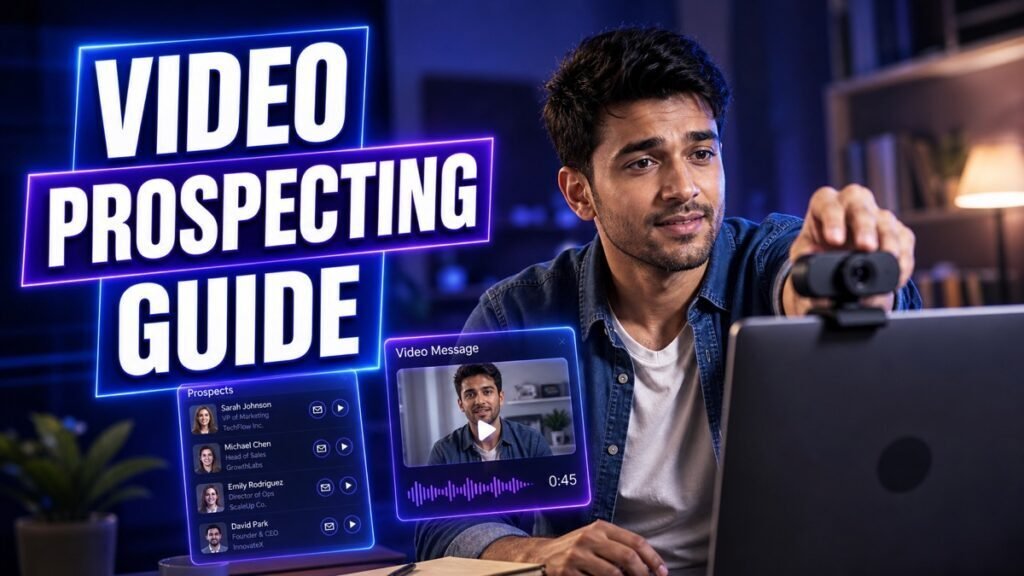
Buyers ignore most cold outreach because it looks like every other message in a crowded inbox. Video prospecting breaks that pattern. Instead of another block of text, a prospect sees your face, hears your voice, and gets a message made for them. This guide explains what video prospecting is, when it works, and exactly how to do it, even if you have never recorded yourself before.
Quick answer: Video prospecting is the use of short, personalized videos in cold and warm outreach to start conversations with potential buyers. It works because it feels human, proves effort, and stands out in text-heavy channels like email and LinkedIn. The goal of a prospecting video is not to close a deal. It is to earn a reply.
Key Takeaways
- Video prospecting adds a personalized video to outreach so you stand out and build trust faster.
- Keep videos short, usually 30 to 60 seconds, with one clear ask.
- Lead with the prospect, not with your product. The first five seconds decide whether they keep watching.
- Video works best inside a sequence, not as a one-time trick. Pair it with text touches.
- Measure replies and meetings booked, not views, to know if it is working.
What Is Video Prospecting?
Video prospecting means recording a brief video, often just you talking to the camera or walking through something on your screen, and sending it to a prospect as part of your outreach. You might drop it into a cold email, a LinkedIn message, or a follow-up after a trigger event like a new role or a funding announcement.
The video is usually paired with a still image thumbnail that shows you waving or holding a sign with the prospect’s name or company. That thumbnail is what appears in the email. When the prospect clicks, they land on a simple page that plays your video, often with a clear next step below it.
This is different from marketing video. You are not producing a polished ad. You are sending a personal message that happens to be on camera. Rough and real beats slick and generic in prospecting.
Why Video Prospecting Works
Three things make video effective in outreach.
It proves effort. Anyone can paste a template. Recording a video for one person signals that you did your homework and that this is not a mass blast. That effort earns attention.
It builds trust quickly. Tone, expression, and body language carry meaning that text cannot. A prospect learns more about whether they like you in ten seconds of video than in ten emails. In B2B, where deals rest on trust, that head start matters.
It stands out. Most inboxes are walls of plain text. A personalized thumbnail with a prospect’s name interrupts the scroll. Curiosity does the rest.
None of this means video is magic. A lazy video with no personalization performs no better than a lazy email. The medium amplifies your message; it does not replace the thinking behind it.
When to Use Video, and When to Skip It
Video is not the right tool for every touch. Use it where the payoff justifies the time.
| Good fit for video | Better to keep it text |
|---|---|
| High-value target accounts | Large, low-value bulk lists |
| After a clear trigger event | Simple scheduling confirmations |
| Breaking into a cold account | Quick one-line questions |
| Re-engaging a stalled deal | Legal or contract details |
| Walking through something visual | When the prospect asked for text only |
A practical rule: if the account is worth ten minutes of research, it is worth a two-minute video. If you would not research the account, do not record for it.
How to Structure a Prospecting Video
Great prospecting videos follow a simple shape. You can learn it in one sitting.
1. The hook (first 5 seconds)
Say the prospect’s name and give an instant reason the message is about them. “Hi Sarah, I saw your team just opened three sales roles, so I recorded this quick note.” Never open with your name and company. Open with them.
2. The reason (10 to 20 seconds)
Connect the trigger to a problem they likely feel. Keep it about their world. “Hiring that fast usually means ramp time becomes a headache, and new reps take months to sound confident on calls.”
3. The value (10 to 20 seconds)
Offer one relevant idea or outcome, not a feature list. “I have a simple way teams cut that ramp time using short training videos, and I put together two examples for a team like yours.”
4. The ask (5 to 10 seconds)
End with one clear, low-friction next step. “Worth a quick 15 minutes next week? Reply here and I will send times.” One ask. Never stack three.
That entire script fits in about 45 seconds. Short respects the prospect’s time and forces you to be clear.
A Simple Script Template
Fill in the brackets and adapt the wording to sound like you.
“Hi [First name], I noticed [specific trigger about them]. Teams in that spot often run into [relevant problem]. I have helped a few [similar companies] handle that by [one-line outcome], and I recorded a couple of examples that might fit [their company]. If it is useful, reply and I will send a time to walk through them. Either way, keep up the great work on [genuine detail].”
Notice the balance. Four of five sentences are about the prospect. Only one mentions what you do. That ratio is the secret to outreach that does not feel like a pitch.
Recording Tips for Beginners
You do not need a studio. You need to be clear and easy to hear.
- Light your face. Sit facing a window or a lamp. Never sit with a bright window behind you.
- Fix your audio. Bad sound loses viewers faster than bad video. A basic headset or earbuds with a mic beats a laptop microphone in a noisy room.
- Look at the lens, not the screen. Eye contact through the camera feels personal. Put a sticky note by the lens as a reminder.
- Raise your energy. Camera flattens enthusiasm. What feels like slightly too much energy usually reads as normal and warm on playback.
- Do not aim for perfect. One or two takes is plenty. A natural stumble is more human than a rehearsed performance.
For a deeper walkthrough of setup and delivery, see our guide on how to record a sales video that gets responses.
Where Video Fits in Your Outreach Sequence
Video is a play inside a sequence, not the whole sequence. Mixing formats keeps outreach fresh and gives prospects several chances to respond.
| Touch | Format | Goal |
|---|---|---|
| 1 | Short text email | Introduce a relevant reason to talk |
| 2 | Personalized video | Stand out and build trust |
| 3 | LinkedIn message or connection | Add a second channel |
| 4 | Text follow-up with value | Share a resource, no ask |
| 5 | Short breakup video | Create urgency and closure |
Placing the first video on touch two works well. The prospect has seen your name once, so the video feels like persistence rather than a surprise. Learn how to weave video across a full cadence in how to add personalized videos to your sales follow-ups.
Personalization at Scale
The most common objection to video is time. Recording a unique video for every prospect does not scale, and it does not need to.
Use a tiered approach. For your top accounts, record fully custom videos. For a mid tier, record a video with a personalized opening line and thumbnail, then reuse a common middle and ending. For broad outreach, use a single strong video that speaks to a specific role or industry, so it still feels relevant even though it is not one to one.
Modern video platforms speed this up with reusable templates, personalized thumbnails, and dynamic landing pages. A tool like Dubb lets you record once, insert a prospect’s name on the page, and track who watched, which keeps the personal feel without the full recording load. Compare options in our roundup of the best video prospecting tools for B2B sales teams.
How to Measure Video Prospecting
Views feel good but do not pay commission. Track the metrics that connect to pipeline.
- Reply rate: the truest sign a video earned attention.
- Meetings booked: the outcome that matters most.
- Watch rate: how far people get tells you if your hook and length are right.
- Click to watch: if few people click, fix your subject line and thumbnail, not the video.
Read each number as a signal about a specific step. Low clicks means your thumbnail and subject line need work. High clicks but low replies means the message or ask needs work. Our guide to video sales metrics breaks this down further.
Common Mistakes to Avoid
- Talking about yourself first. Lead with the prospect or lose them in five seconds.
- Going too long. Over 90 seconds and watch rates fall fast. Cut ruthlessly.
- Stacking asks. One next step per video. Choices create delay.
- Faking personalization. A generic video with a name pasted on top fools no one. Reference something real.
- Chasing production value. Prospects reward relevance, not lighting kits.
Video for Cold Versus Warm Prospects
The same video does not fit every relationship, so adjust your approach to the temperature of the contact.
For cold prospects who have never heard from you, spend most of your effort on the hook and the personalization. They owe you nothing, so the first five seconds must prove the message is about them. Keep the ask tiny, such as a simple reply, rather than asking for a 30-minute call from someone who does not know you yet.
For warm prospects who have engaged before, you can move faster to value and make a slightly bigger ask. They already know your name, so a quick reminder of your last conversation replaces the cold hook. Reference the specific thing that connected you, then advance the conversation to a concrete next step.
The mistake to avoid is treating a warm lead like a stranger, which wastes their time, or treating a cold lead like a friend, which feels pushy. Read the relationship, then match your tone and your ask to it.
What If You Hate Being on Camera?
Most people dislike watching themselves at first, and that feeling fades with practice. A few tactics make the early days easier.
- Start with screen recordings. If facing the lens feels like too much, begin with a screen share and just your voice. You still get the personal touch without being fully on camera, and you can add your face later.
- Record in short bursts. A 30-second video is far less intimidating than a three-minute one. Short is also more effective, so the easier path is also the better one.
- Do not rewatch obsessively. Check the first take for clarity and audio, then send. Studying every frame only feeds the nerves.
- Remember the standard. Prospects are not judging you against a news anchor. They are comparing you to the twenty plain-text emails around yours, and a real human wins that comparison easily.
Confidence is a byproduct of reps. Record ten videos and the eleventh will feel natural. Our guide on how to record a sales video covers delivery in more depth.
Frequently Asked Questions
How long should a prospecting video be?
Aim for 30 to 60 seconds. Long enough to be relevant, short enough to respect a busy calendar. Only go longer when you are walking through something visual the prospect asked about.
Do I need a fancy camera?
No. A laptop or phone camera with good lighting and clear audio is enough. Clarity and relevance matter far more than gear.
What should the thumbnail show?
Your face, smiling, ideally with a personal touch like the prospect’s name or company on a sign. The thumbnail earns the click, so make it obviously human and specific.
Does video prospecting work on LinkedIn?
Yes. Video messages stand out in LinkedIn just as they do in email. Keep them even shorter, since the context is more casual.
Conclusion
Video prospecting works because it does the one thing cold outreach usually fails at: it feels human. You do not need talent or gear. You need to lead with the prospect, keep it short, make one clear ask, and use video where the account is worth the effort. Start with your top ten target accounts this week. Record a 45-second video for each using the script above, and measure replies.
Ready to try it with tracking and personalized pages built in? Start free with Dubb and send your first prospecting video today.