
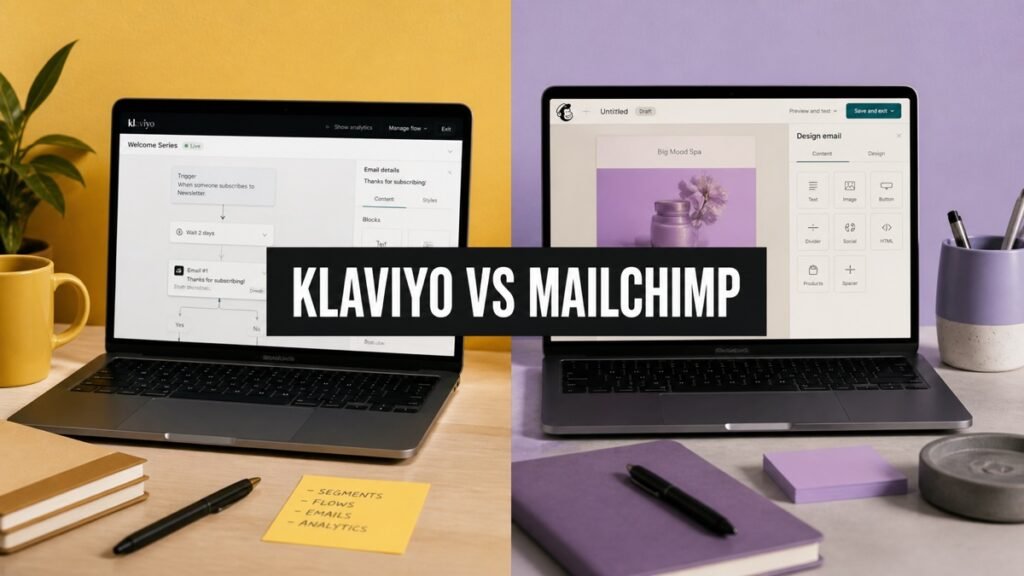
This comparison has a clear answer more often than most, and it turns on one question: do you sell products online?
If yes, with meaningful order volume, Klaviyo does things Mailchimp structurally cannot, and the revenue difference usually exceeds the price difference. If no, Klaviyo is expensive for what you would actually use, and Mailchimp is the better choice.
The reason is the data model, not the feature list.
The Structural Difference
Mailchimp organises around audiences and tags. A contact belongs to an audience; you layer segments on top. It knows who someone is and roughly what they have clicked.
Klaviyo organises around profiles and events. Every action a customer takes — viewed a product, added to cart, started checkout, placed an order, left a review — is a timestamped event on their profile, with the full product data attached.
That attachment is the whole difference. Klaviyo does not just know someone abandoned a cart; it knows the cart contained a £180 jacket from the Outerwear category, that they have ordered twice before, and that their average order value is rising.
So you can build a segment like “abandoned a cart over £100, has ordered before, has not purchased in 60 days” and trigger a flow on it. Mailchimp cannot express that, because it never stored the cart contents as structured data in the first place.
Where Klaviyo Wins
Ecommerce flows
Abandoned cart, browse abandonment, post-purchase, replenishment reminders, win-back — all built around real order data. Klaviyo’s abandoned cart email shows the actual products with images and prices pulled live.
Mailchimp has abandoned cart. It is materially less capable at this.
Predictive analytics
On sufficient order history, Klaviyo predicts customer lifetime value, expected next order date and churn risk, and lets you segment on those predictions. Genuinely useful for deciding who deserves a discount and who does not.
Segmentation depth
Segments defined on any combination of events, properties and predictions, updating themselves continuously. This is where the event model pays off repeatedly.
Revenue attribution
Klaviyo reports revenue per flow and per campaign as standard. You can see that your abandoned cart series produced a specific amount last month. That reporting is why marketers defend the price.
SMS in the same system
Email and SMS sharing one profile and one set of flows, rather than bolted together.
Where Mailchimp Wins
Price, substantially, for non-ecommerce
Mailchimp has a free tier and lower entry pricing. If you send a newsletter, Klaviyo’s advantages are irrelevant and you are paying for an engine with no fuel.
Ease of use
Friendlier for a first-time user, with better templates out of the box and a gentler learning curve. Klaviyo assumes some comfort with event-based thinking.
Breadth beyond email
Landing pages, forms, social posting, basic CRM, appointment booking and more. Mailchimp has expanded into a small marketing suite; Klaviyo has stayed focused.
Non-ecommerce use cases
Nonprofits, service businesses, publishers, B2B — Mailchimp fits these comfortably. Klaviyo is built for stores and it shows.
Head to Head
| Klaviyo | Mailchimp | |
|---|---|---|
| Data model | Profiles and events | Audiences and tags |
| Product data in emails | Native | Limited |
| Abandoned cart | Strong | Basic |
| Predictive analytics | Yes | Limited |
| Revenue attribution | Standard | Limited |
| SMS | Integrated | Available |
| Free tier | Limited | Yes |
| Template quality | Good | Strong |
| Landing pages / forms | Basic | Better |
| Learning curve | Moderate | Gentle |
| Best fit | Online stores | Newsletters, service businesses |
Klaviyo prices by active profiles and SMS volume; Mailchimp by contacts with feature tiers. Both have raised prices in recent years. Verify current pricing and model it against your real list size — the pricing bases are different enough that entry prices mislead.
The Cost Question, Honestly
Klaviyo is more expensive at comparable list sizes, and the argument for it is that attributed revenue exceeds the difference.
That argument holds for stores with real order volume. It does not hold automatically. If your store does modest revenue, the flows will not generate enough to cover the gap, and you would be better on Mailchimp or a cheaper ecommerce-focused option like Omnisend.
The useful test: Klaviyo reports revenue per flow. If you migrate and your flows do not attribute meaningfully more than the price difference within a few months, the move was wrong. That is measurable rather than a matter of opinion.
Which Should You Choose?
Choose Klaviyo if: you run an online store with meaningful order volume, you want flows triggered on real product and order data, you need revenue attribution per flow, or you want email and SMS in one system.
Choose Mailchimp if: you do not sell products online, you send a regular newsletter, you want to start free, design quality matters and you have no designer, or your list is small enough that Klaviyo’s pricing is not justified by the return.
Consider neither if: you are a small store on a tight budget — Omnisend covers much of Klaviyo’s ecommerce territory for less. If you are B2B with a sales process, ActiveCampaign fits better than either.
Migration Notes
Covered in depth in our dedicated guide, but the essentials:
- Connect your store to Klaviyo before importing contacts. Klaviyo builds profiles from order history; importing a CSV first creates duplicates with no purchase data.
- Clean your list first. You pay per active profile from day one.
- Carry consent status and opt-in dates across. You need them to evidence lawful basis under GDPR and PECR.
- Automations never transfer. Rebuild your top three flows first.
- Warm up sending gradually and authenticate your domain with SPF, DKIM and DMARC before the first send — the 2024 Google and Yahoo bulk sender requirements make this mandatory.
Common Mistakes to Avoid
- Moving to Klaviyo without a store. Its value is the ecommerce data model. Without orders flowing in you are paying for an empty engine.
- Assuming the price difference pays for itself. It does at volume. Measure attributed revenue and be willing to move back.
- Recreating tag-based segments literally. Rebuild them as behavioural definitions or they go stale immediately.
- Forgetting the purchase-exclusion on abandoned cart. The most common configuration error — it emails customers about orders they already completed.
- Letting inactive profiles accumulate. Both bill on list size. Prune quarterly; it cuts cost and improves deliverability.
- Ignoring deliverability basics. Neither platform rescues you from an unauthenticated domain or a dirty list.
- Comparing entry prices. Different pricing bases. Model your own numbers.
FAQs
Is Klaviyo better than Mailchimp?
For ecommerce, meaningfully yes — the event and product data model does things Mailchimp cannot express. For newsletters and service businesses, Mailchimp is better and considerably cheaper.
Is Klaviyo worth the extra cost?
For a store with real order volume, usually — and it is measurable, because Klaviyo reports revenue per flow. If attributed revenue does not exceed the price difference after a few months, it was the wrong move.
Does Mailchimp have abandoned cart emails?
Yes, and they are less capable. Mailchimp does not store cart contents as structured product data the way Klaviyo does, which limits both the email content and the segmentation you can build on it.
Can I use Klaviyo without an online store?
You can, and you would be paying for capability you cannot use. Klaviyo’s pricing assumes you are using the ecommerce features.
Which has better deliverability?
Both are established senders with good infrastructure. The difference between them is far smaller than the difference your own list hygiene and domain authentication make.
Is there a cheaper alternative to Klaviyo for ecommerce?
Omnisend covers much of the same territory at lower cost with email and SMS combined. Worth pricing if your store is small enough that Klaviyo’s pricing is hard to justify.
Key Takeaways
- The question is whether you sell products online. If not, Mailchimp.
- Klaviyo stores events with full product data attached; Mailchimp stores contacts and tags.
- Klaviyo’s revenue-per-flow reporting makes the price argument measurable rather than a matter of faith.
- For small stores, Omnisend may cover the need for less.
- Connect your store before importing contacts, or you get duplicate profiles with no order history.
Making the Call
If you run a store, look at your monthly order volume and ask whether a percentage improvement in repeat purchase would cover the price difference. That is the entire decision, and Klaviyo will tell you afterwards whether you were right.
If you are moving, our step-by-step migration guide covers the ordering that avoids duplicate profiles. For the non-ecommerce case, see ActiveCampaign vs Mailchimp.