
Disclosure: This comparison is published by Dubb, one of the two tools below. We have worked to compare both fairly, including where Covideo is the better choice. Details were verified on each company’s official site in early 2026; confirm current information before deciding.
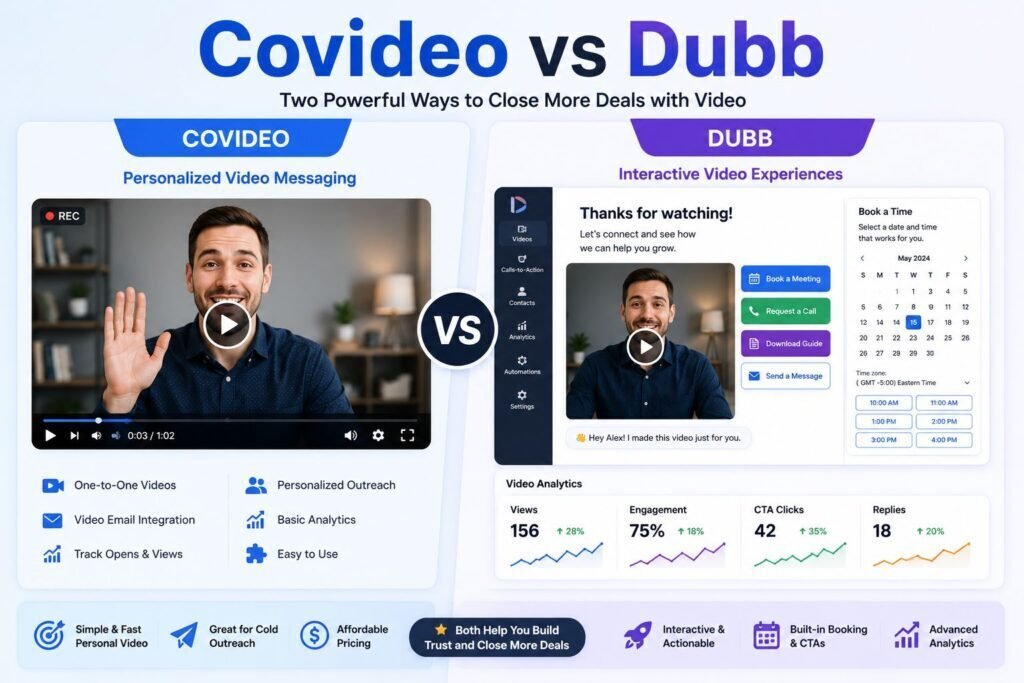
Covideo and Dubb are both sales video platforms that help you record, send, and track personal videos. Covideo is an established tool with a strong focus on automotive and dealership sales, known for a support-oriented approach and quote-based pricing. Dubb is an all-in-one sales video platform serving a broad range of industries, with transparent pricing, a free plan, and a full conversion workflow including video email, SMS, landing pages, CTAs, and automation. This guide compares them fairly.
Quick verdict: Choose Covideo if you are in automotive or dealership sales and want an established, support-focused video tool built around that world. Choose Dubb if you want an all-in-one sales video platform with transparent pricing, a free plan, and a full multichannel workflow that suits a broad range of industries. Both record and send video well; the fit depends on your industry and whether you prefer quote-based or transparent, self-serve pricing.
Key Takeaways
- Covideo is established and strongly focused on automotive and dealership sales.
- Dubb is an all-in-one sales video platform for many industries, with a free plan.
- Covideo uses quote-based pricing; Dubb publishes transparent tier pricing from a free plan (verify).
- Both offer recording, sending, and tracking; Dubb adds SMS, landing pages, CTAs, and automation.
- Choose Covideo for dealership-focused sales; Dubb for a transparent, all-in-one platform.
Covideo vs Dubb at a Glance
| Dimension | Covideo | Dubb |
|---|---|---|
| Core focus | Sales video, strong in dealerships/automotive | All-in-one sales video, broad industries |
| Pricing model | Quote-based (contact for pricing) | Transparent tiers with a free plan |
| Free option | Free trial (verify) | Free Starter plan |
| Video email | Yes | Yes |
| Video SMS | Verify | Yes |
| Landing pages and CTAs | Verify | Landing pages with custom CTAs |
| AI | AI Suite (create, accelerate, enhance) | AI Productivity Suite, Sales Agent |
| Best for | Automotive and dealership sales teams | Sales teams across industries |
Verified early 2026; confirm current pricing and features on each site. Covideo pricing is quote-based and not published.
Industry Focus: Covideo’s Strength
Covideo has built a strong reputation in specific verticals, especially automotive dealerships, along with RV, marine, and powersports dealers. Its marketing highlights dealership success stories and metrics, and its product and support are oriented toward that world. For a dealership that wants a video tool from a vendor that understands their industry, with case studies and support tuned to their needs, Covideo’s focus is a genuine advantage. Established tools with deep industry roots can offer a level of vertical understanding that broader platforms do not, and Covideo’s dealership focus is its clearest strength.
Breadth and Transparency: Dubb’s Strength
Dubb serves a wide range of industries, from B2B sales and real estate to recruiting and customer success, with an all-in-one workflow: video email, SMS, landing pages, CTAs, campaigns, automation, and tracking, plus the Dubb Sales Agent. It also publishes transparent tier pricing and offers a free plan, so you can try it and understand the cost without contacting sales. For teams that want a broadly applicable platform and prefer to evaluate and buy on their own terms, Dubb’s breadth and pricing transparency are the draw. If your industry is not automotive, a general-purpose platform may fit more naturally.
Pricing and How You Buy
A key practical difference is how the two are priced and sold. Covideo uses quote-based pricing: its site directs you to request a quote or a demo rather than listing plan prices, which is common for tools that sell into specific industries with tailored packages. Dubb publishes its pricing openly, with a free Starter plan, Pro from around $59 per month, Pro Plus around $129 per month, and custom Enterprise, plus the Sales Agent add-on around $50 per month. If you prefer to see pricing upfront, start free, and buy self-serve, Dubb’s transparency suits you. If you are comfortable with a consultative sales process and a tailored quote, Covideo’s model is normal for its market. Verify current details on both sites, since Covideo’s pricing is not public.
Features Compared
Both cover the core of sales video: recording, video email, and tracking, and both have added AI, Covideo through its AI Suite (described as create, accelerate, and enhance) and Dubb through its Productivity Suite and Sales Agent. Dubb’s all-in-one scope adds video SMS, landing pages with CTAs, and automation as part of one workflow. For Covideo, verify the current specifics of its landing pages, SMS, and automation capabilities, since its site emphasizes outcomes and industry fit more than a public feature-by-feature breakdown. As always, match the specific features you need to what each tool currently offers.
Who Should Choose Covideo
- Automotive, RV, marine, and powersports dealerships.
- Teams that want a vendor with deep industry focus and support.
- Buyers comfortable with a consultative, quote-based purchase.
- Sellers who value established case studies in their vertical.
Who Should Choose Dubb
- Sales teams across a broad range of industries.
- Anyone who wants transparent pricing and a free plan to start.
- Teams that want an all-in-one workflow with SMS, pages, CTAs, and automation.
- Buyers who prefer to evaluate and purchase self-serve.
Ease of Evaluation
One underrated difference is simply how easy each is to try. Dubb’s free plan and public pricing let you sign up and test it in minutes, on your own, which suits teams that like to evaluate before talking to sales. Covideo’s model routes you through a trial and a conversation with its team, which can be valuable if you want guidance tailored to your dealership but adds a step if you prefer to explore independently. Consider how your team likes to buy software. If you want to start today without a sales call, Dubb’s self-serve approach fits; if you want a guided evaluation for your specific vertical, Covideo’s approach works.
Limitations to Weigh
Covideo’s strong vertical focus on dealerships may make it less of a natural fit outside automotive and related industries, and its quote-based pricing means you cannot easily compare costs without contacting the company. Dubb’s breadth means it is not specialized to any single industry’s workflow the way a vertical tool is, and some features sit on higher tiers. Weigh Covideo’s industry depth against Dubb’s breadth, transparency, and free plan, based on your industry and how you prefer to buy.
Vertical Focus Versus General Purpose
This comparison is really about a classic software tradeoff: a vertically focused tool versus a general-purpose platform. Covideo’s deep roots in automotive and dealership sales mean its product, case studies, and support are shaped by that world. For a dealership, that focus can translate into a vendor that speaks your language, understands your sales process, and has proof that video works in your specific industry. Vertical tools often earn loyalty precisely because they are not trying to be everything to everyone, and Covideo’s dealership specialization is a real asset for buyers in that market.
Dubb takes the general-purpose route, serving sales teams across many industries with an all-in-one workflow and transparent, self-serve pricing. The advantage is flexibility and accessibility: you can start free, see the cost upfront, and apply the tool to almost any sales motion, whether you are in real estate, B2B software, recruiting, or customer success. The tradeoff is that a general platform is not tuned to one industry’s exact workflow the way a vertical tool is. So the decision comes down to whether your industry benefits from a specialist, as automotive dealerships may with Covideo, or whether a flexible, transparent, broadly applicable platform like Dubb serves you better. Neither answer is universally right; it depends on how specialized your needs are.
Frequently Asked Questions
Is Covideo only for car dealerships?
Covideo is strongly focused on automotive and dealership sales, including RV, marine, and powersports, though it can serve other sales use cases. If you are in those industries, its focus is a strength; if not, a general-purpose platform like Dubb may fit more naturally. Verify current positioning on its site.
How much does Covideo cost?
Covideo uses quote-based pricing and does not publish plan prices, directing you to request a quote or demo. Dubb publishes transparent pricing with a free plan. To compare costs, you will need a quote from Covideo. Verify current details on both sites.
Which is easier to try?
Dubb’s free plan and public pricing let you start on your own in minutes. Covideo routes you through a trial and a conversation with its team. Choose based on whether you prefer self-serve evaluation or a guided one.
Do both offer video email and tracking?
Yes, both offer video email and engagement tracking. Dubb adds SMS, landing pages, CTAs, and automation in one workflow. Verify Covideo’s current specifics, since its site emphasizes outcomes over a public feature list.
The Buying Experience Matters
Beyond features, the way you buy and get supported can shape your experience with a tool for years, so it is worth weighing. Covideo’s consultative, quote-based model means you engage with its team, get a tailored package, and often receive hands-on guidance suited to your dealership. For buyers who value a guided setup and a vendor relationship, especially in a specialized industry, that high-touch approach is a genuine benefit. The tradeoff is that you cannot simply sign up and compare prices on your own; you go through a conversation first.
Dubb’s self-serve, transparent model means you can start free, see pricing openly, and begin using the product immediately, with support available as you grow. For teams that prefer to explore independently and buy without a sales call, that accessibility is a real advantage. Neither approach is better in the abstract; they suit different buyers. A dealership that wants a specialist partner may appreciate Covideo’s guided process, while a team that wants to test and adopt quickly may prefer Dubb’s open, self-serve path.
How to Evaluate the Two
To choose well, weigh three things: industry fit, buying preference, and the specific features you need. If you are in automotive or a related dealership vertical and want a vendor tuned to that world, request a Covideo demo and see whether its industry focus and support match your needs. If you want a broadly applicable, transparent, self-serve platform, start Dubb’s free plan and test it with your real outreach. In both cases, confirm the current details, Covideo’s pricing via a quote, and Dubb’s on its pricing page, and check that each tool includes the specific capabilities you need, such as SMS, landing pages, or automation. Matching the tool to your industry, your buying style, and your feature requirements will point you to the right choice.
Verdict
Covideo and Dubb are both capable sales video tools with different orientations. Covideo is a strong, established choice for automotive and dealership sales, with deep industry focus and a support-oriented, quote-based model. Dubb is an all-in-one sales video platform for a broad range of industries, with transparent pricing, a free plan, and a full multichannel workflow. If you run a dealership and want an industry-focused vendor, Covideo is worth a close look; if you want a broadly applicable, transparent, self-serve platform, Dubb fits. Try Dubb’s free plan, and request a Covideo demo, before you decide. Let your industry, your buying preference, and a hands-on look at each decide the winner, since the right answer genuinely depends on whether you want a dealership specialist or a transparent, general-purpose platform. And because Covideo’s pricing is quote-based, be sure to get a current quote so you can compare the real cost against Dubb’s published plans before you commit, because pricing is often the deciding factor once the feature needs are met on both sides, and a transparent plan you can start today has a real advantage over a quote you have to wait for.
Want a transparent, all-in-one sales video platform free to start? Start free with Dubb and compare it against Covideo.