
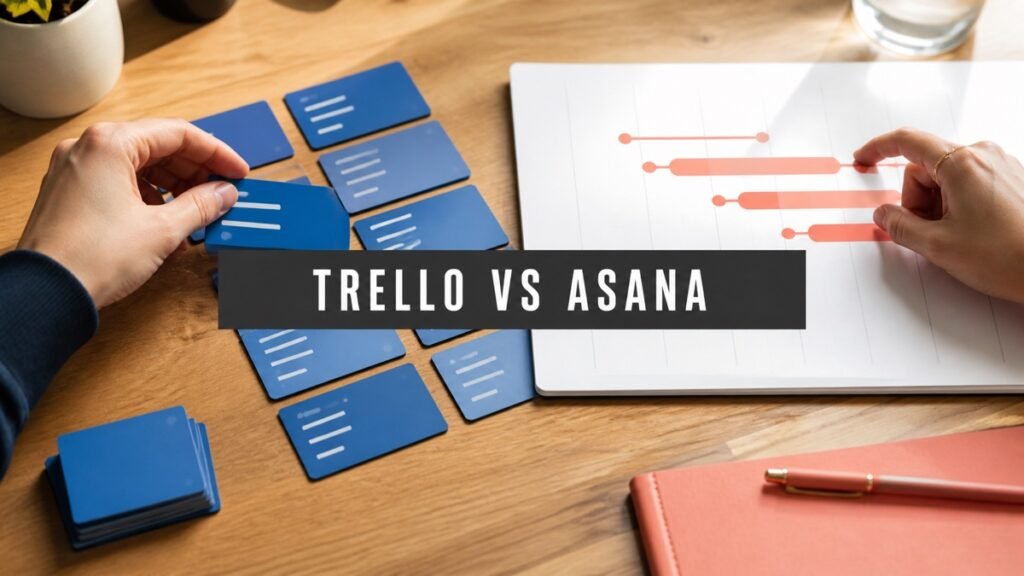
Trello is built around cards moving through lists. Asana is built around tasks with owners, dates and project memberships. Both can coordinate work, but the better fit depends on whether your work is a visible pipeline or a set of commitments with dependencies.
This comparison uses official plan and help information rather than a hands-on test. Prices, plan boundaries and features change; verify the current package before moving a team.
Where Trello fits
Trello is quick to understand. A small team can create a board, add cards and move them through stages. Current Trello plans also include features such as Inbox, Planner, automation and Power-Ups, while higher plans add advanced checklists, card mirroring and custom fields.
Advanced checklist items can have members and due dates on the applicable plan, and Trello’s Home and search tools can surface assigned cards and checklist items. That corrects the old blanket claim that checklist items are always ownerless and that every person must open each board to find assigned work.
Trello card mirroring can keep a linked card visible across boards, but it is not the same as a full dependency graph. Test what is mirrored, what remains in the source card and what your plan includes.
Where Asana fits
Asana tasks have a single assignee, dates, followers, comments and project memberships. A task can be multi-homed across projects. Timeline and Gantt views, forms, rules and reporting features are plan-dependent. That structure suits deadline-driven client delivery and work that depends on another deliverable.
Asana’s Personal plan is free for one or two people. Starter is listed at $10.99 per user per month billed annually. Treat the free plan as a defined scope, not as proof that the paid workflow will suit you or as a useless trial.
Migration needs a record-by-record check
Before moving, label Trello boards active, archived or disposable. Capture cards, descriptions, members, dates, attachments, comments, checklists, automations, Power-Ups and linked cards. The destination may import some card data while requiring views, rules, mirrored cards and integrations to be rebuilt.
Do not promise that an importer preserves every field or that a two-week move pays for itself. Run a sample import, compare counts and owners, and keep the original board available until the new workflow has passed acceptance.
Choose using a controlled test
- Build one small pipeline in Trello and one owned project in Asana.
- Test a due date, an assigned checklist item, a dependency and a changed scope.
- Check a guest view and confirm internal comments and files stay private.
- Test search and personal work views across multiple boards or projects.
- Export the sample and document what does not travel.
- Compare the actual plan, seats, guests, automation and integration costs.
For a wider comparison, read the small-business project-management shortlist and the Trello migration guide. If a website enquiry, CRM record and project card must stay in sync, ask AdNxt about an integration.