
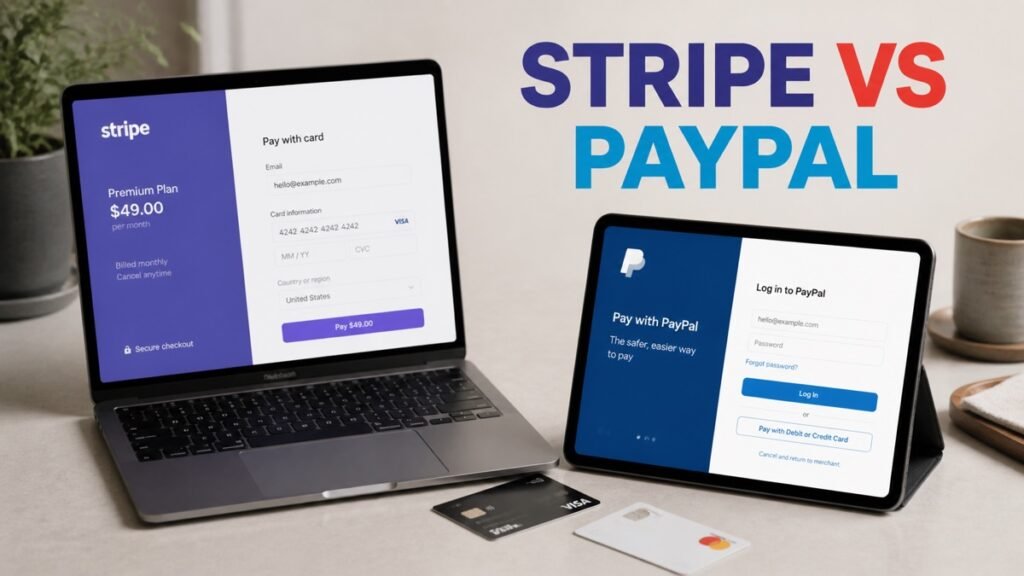
The honest answer for most small businesses is both, and that is not a cop-out — it is what the data on checkout abandonment supports. Offering PayPal alongside card payments generally increases conversion, because a meaningful share of buyers will not enter card details on a site they do not know.
But if you must choose one, or you are deciding which handles your primary checkout, the products differ in ways that matter more than their headline rates.
The Difference in One Line
Stripe is payment infrastructure. It processes cards on your site, under your brand, with the money settling to your bank account on a schedule. You are the merchant.
PayPal is a payment network with a wallet. Buyers have PayPal accounts and balances, they recognise the brand, and PayPal sits between you and them — holding funds, adjudicating disputes and applying its own policies.
That intermediary position is PayPal’s greatest strength for conversion and its greatest risk for you.
The Account Hold Problem
This deserves prominence rather than a footnote, because it is the most consequential difference and the one small businesses discover at the worst time.
PayPal can and does place holds, reserves and limitations on merchant accounts, sometimes without much warning. Common triggers include a sudden increase in volume, a spike in disputes, selling in a category PayPal considers higher risk, or a pattern its systems flag as unusual.
When it happens, funds can be inaccessible while the account is reviewed. For a business that depends on that cash flow, that is genuinely serious. Reports of this are widespread enough that it should factor into your decision.
Stripe is not immune — it also reviews accounts and can impose reserves or close accounts in restricted categories — but merchant complaints about sudden holds are markedly more common with PayPal.
Practical mitigations regardless of which you use:
- Do not let a single processor be your only route to revenue
- Keep a cash buffer that does not depend on this week’s settlements
- Read the acceptable use policy for your category before you start
- Transfer settled funds to your bank regularly rather than leaving balances
- Respond to verification requests immediately — most holds resolve faster with documentation
Where Stripe Wins
Checkout experience
Payment happens on your site, under your brand, without redirecting anywhere. Stripe Checkout and Payment Elements are well-designed and heavily optimised.
Subscriptions and billing
Stripe Billing handles recurring payments, trials, proration, usage-based pricing, dunning and failed-payment retries properly. If you sell subscriptions, this is a substantial advantage.
Developer experience
Best in class, and not close. Documentation, APIs, test mode and libraries are why Stripe won the developer market. If you have any custom requirement, this matters.
Reporting and reconciliation
Clearer reporting, better exports, and accounting integrations that reconcile properly.
Breadth
Invoicing, terminal for in-person payments, financial connections, tax calculation and more — all within one account.
Where PayPal Wins
Buyer trust and conversion
The main argument. Buyers who will not enter card details on an unfamiliar site will pay with PayPal, because their details are already there and they trust the dispute process.
For a new or small brand, this is worth real money and it is why the “both” answer is usually right.
Speed to start
You can accept payments almost immediately with minimal setup. Stripe requires more configuration.
International reach
Available in more countries with broad currency support, which matters if Stripe is unavailable where you operate.
Buyer-side familiarity
Refunds and disputes go through a process buyers understand, which reduces support burden even when it goes against you.
Head to Head
| Stripe | PayPal | |
|---|---|---|
| Model | Payment infrastructure | Payment network and wallet |
| Checkout location | Your site, your brand | PayPal-branded, often redirect |
| Buyer trust benefit | Low | High |
| Subscriptions | Excellent | Adequate |
| Developer experience | Best in class | Weaker |
| Setup speed | Moderate | Fast |
| Reporting | Strong | Adequate |
| Account hold risk | Lower | Higher reported incidence |
| Country coverage | Broad | Broader |
| In-person payments | Stripe Terminal | Zettle |
Both publish per-transaction rates that look similar and diverge in the details. Verify current pricing for your country and card mix directly — and read the section below before comparing.
Where the Real Cost Hides
Headline rates are the least useful number in payment processing.
Currency conversion. Both apply a margin on top of the exchange rate when converting. If you sell internationally, this frequently exceeds the transaction fee itself. Compare conversion margins, not just processing rates.
Cross-border fees. Additional charges when the card was issued in a different country from your account. Real money for international sellers.
Chargeback and dispute fees. Both charge a fee per dispute, and you generally pay it whether or not you win.
Payout timing. Money in the processor is not money in your bank. Check settlement schedules, especially for new accounts where rolling reserves may apply.
Micropayment rates. If your average transaction is small, the fixed per-transaction component dominates. Both offer micropayment pricing on request; ask.
Model your actual mix — average order value, international share, dispute rate — rather than comparing advertised percentages.
Which Should You Choose?
Use Stripe as your primary processor if: you want checkout on your own site, you sell subscriptions, you have any custom development need, or reconciliation and reporting matter to you.
Use PayPal if: your buyers do not know your brand, you sell internationally where Stripe is unavailable, or you need to start accepting payments today.
Use both — the usual right answer. Stripe for card payments in your own checkout, PayPal as an additional option at checkout. The conversion lift from offering PayPal typically exceeds the small extra reconciliation work.
Consider alternatives too: Square if you also sell in person and want one system; Adyen or Mollie in Europe; Shopify Payments if you are on Shopify, where using anything else incurs an additional fee.
Common Mistakes to Avoid
- Relying on one processor entirely. A hold or account issue stops your revenue completely. Have a second route configured.
- Comparing headline rates only. Currency conversion margins and cross-border fees frequently matter more.
- Leaving balances in the processor. Transfer settled funds to your bank regularly.
- Not reading the acceptable use policy. Some categories are restricted or prohibited, and finding out after a hold is expensive.
- Ignoring dispute response deadlines. Both give you a window to respond with evidence. Missing it forfeits the chargeback automatically.
- Not keeping delivery evidence. Tracking numbers and delivery confirmation are what win disputes. Keep them.
- Forgetting Strong Customer Authentication. If you sell into the EU or UK, SCA requirements apply. Both handle it; make sure it is configured.
- Storing card details yourself. Do not. Use the processor’s tokenisation, and keep PCI scope minimal.
FAQs
Should I offer both Stripe and PayPal?
For most ecommerce, yes. Offering PayPal alongside cards generally lifts conversion because some buyers will not enter card details on an unfamiliar site. The extra reconciliation work is minor by comparison.
Which is cheaper?
Headline rates are close, and the answer depends on your mix. Currency conversion margins, cross-border fees and dispute costs usually matter more than the advertised percentage. Model your own numbers.
Can PayPal freeze my money?
PayPal can place holds, reserves and limitations on merchant accounts, and reports of this are common enough to plan around. Keep a cash buffer, transfer funds regularly, respond to verification requests immediately, and have a second processor configured.
Is Stripe better for subscriptions?
Yes, meaningfully. Stripe Billing handles trials, proration, usage-based pricing, dunning and failed-payment retries properly. PayPal’s recurring capability is adequate but less complete.
Do I need to be PCI compliant?
You have PCI obligations whenever you accept cards, though using a processor’s hosted fields or tokenisation keeps your scope minimal. Never store raw card details yourself. Both provide guidance on the applicable self-assessment.
What about Strong Customer Authentication?
SCA applies to sales into the EU and UK, requiring additional authentication on many transactions. Both processors support it. Confirm it is configured correctly, since failures show up as declined payments.
Key Takeaways
- For most ecommerce, offering both is the right answer — PayPal lifts conversion for unfamiliar brands.
- PayPal’s intermediary position drives both the trust benefit and the account hold risk.
- Never rely on a single processor; a hold stops revenue entirely.
- Currency conversion margins usually cost more than the headline rate difference.
- Keep delivery evidence and respond to disputes within the deadline.
Making the Call
Set up Stripe as your primary checkout and add PayPal as a second option. If your average order value is small or you sell heavily internationally, ask both about micropayment and cross-border pricing before committing — those conversations are worth having and rarely happen.
For related decisions, see our guides to invoicing software and Squarespace vs Shopify, where payment processing choices are partly made for you.