
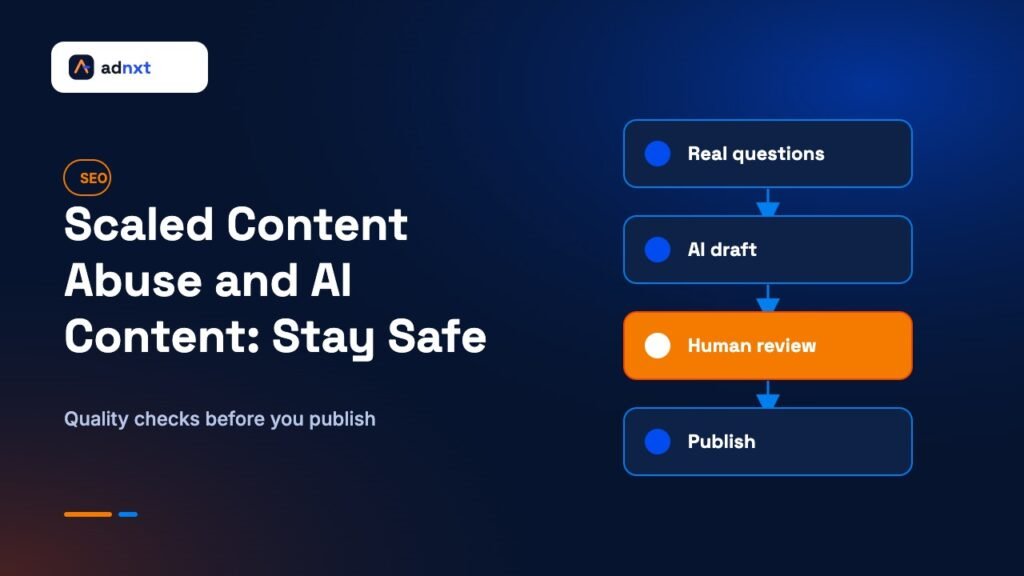
AI tools make it easy to publish a lot of pages very quickly. A business can now produce a hundred city pages, a thousand product descriptions, or a blog post for every question in its industry in a single afternoon. The temptation is obvious: more pages should mean more chances to show up in search. The problem is that Google has a spam policy aimed squarely at this kind of shortcut, and it does not care whether a person, a script, or an AI model did the writing.
This guide explains Google’s scaled content abuse policy in plain English, what a recent high-profile example tells business owners, and how to use AI in your content process without putting your website’s search visibility at risk. It is written for owners and marketing leads in the US and Canada who publish content to win customers, not for SEO specialists.
Key takeaways
- Google defines scaled content abuse as creating many pages mainly to manipulate rankings rather than help people. How the pages were made does not change that.
- Using AI is allowed. Publishing large volumes of unoriginal, low-value pages is the risk, with or without AI.
- The safest test for each page: would it be useful to a real visitor if search engines did not exist?
- Build a review step into any AI-assisted workflow, and publish in planned batches you can check.
- If you already have thin pages, improve, merge, or remove them before adding more.
The news roundup behind this guide
This topic came up in Barry Schwartz’s weekly Search Engine Roundtable video recap, “Google Scaled Content Abuse From Facebook, ChatGPT Search 20% Of Google & More SEO, PPC & Local,” published on November 6, 2026. One of the lead stories was about Facebook Answers: according to the roundup, which cites reporting by Saul Westbrook and comments from Glenn Gabe, millions of AI-generated Facebook Answers pages, built from public posts, had been indexed by Google and were ranking for many searches. Schwartz and others questioned whether pages like that fit within Google’s scaled content abuse policy. The video covers many other search updates too. AdNxt is not affiliated with the channel. Watch the original on YouTube.
We are not judging Meta’s pages here; Google has not publicly announced any action on them as far as we know. The example is useful because it shows the question every content team now faces: when does publishing at scale help people, and when does it just fill search results?
What scaled content abuse means
Google introduced the scaled content abuse policy in March 2024, alongside a core update and two other new spam policies. In its announcement, Google described it as generating many pages for the primary purpose of manipulating search rankings and not helping users. Google also said it can act on scaled content abuse whether the content is produced through automation, human effort, or a mix of both. You can read the original explanation in Google’s post, What web creators should know about our March 2024 core update and new spam policies.
In practical terms, the policy is about purpose and value, not the tool. A few patterns that commonly cause problems:
- Hundreds of near-identical pages that swap in a city name, product name, or keyword but say nothing new.
- Pages that stitch together text from other websites without adding anything of your own.
- Large batches of AI-written articles published with no fact checking or editing.
- Pages created only because a keyword tool showed search volume, with no real answer behind them.
Sites that violate Google’s spam policies can rank lower or disappear from results. Some receive a manual action notice in Search Console. Others simply see traffic fall after a spam or core update.
Is using AI for content against Google’s rules?
No. Google has said repeatedly that what matters is the quality and purpose of content, not how it was produced. AI can help you research, outline, draft, and edit. Many good websites use it.
What changes with AI is speed. A team that once published four articles a month can now publish four hundred. If the quality bar stays the same, that is a real advantage. If the bar drops because there is no time to review, the site can drift into exactly the pattern the policy describes. The risk is not the AI. It is skipping the human judgment that makes each page worth publishing.
A simple test for every page
Before publishing any page, ask one question: if search engines did not exist, would this page still be useful to a real visitor who found it through your menu, a link, or a newsletter?
Then check these points:
- Does it answer a real question your customers ask, in more depth or with more clarity than a quick summary?
- Does it include something only you can add, such as your process, local knowledge, photos of your own work, pricing guidance, or lessons from projects?
- Is it accurate? Have dates, numbers, product details, and claims been checked against reliable sources?
- Is it different from your other pages? If you have ten pages that say almost the same thing, visitors and search engines both get less from each one.
- Would you be comfortable if a customer read it? If a page would embarrass you in front of a client, it should not be live.
Pages that pass this test are not scaled content abuse, even if AI helped write them. Pages that fail it are a risk, even if a person wrote every word.
Where businesses most often cross the line
City and service-area pages
Service businesses often want a page for every town they serve. That can be fine when each page has real local value: projects completed in that area, local rules or permits, travel times, local team members, or reviews from customers there. It becomes a problem when the pages are copies with the town name swapped. If you cannot say something specific about an area, a single well-built service-area page with a clear list of locations is usually a better choice.
Product descriptions
Stores with large catalogs often use manufacturer text or AI to fill descriptions. Thin or copied descriptions across thousands of products make it hard for search engines to see what is special about your store. Start with your best sellers and most important categories. Add real details: sizing advice, materials, use cases, care, and answers to the questions your support team hears.
Glossaries and “what is” pages
Definition pages can help visitors, but a glossary of hundreds of generic terms rarely adds anything. Keep the terms your customers actually need, and connect each to your services or guides.
Programmatic comparison pages
Pages comparing every product with every other product can grow into thousands of URLs. If you cannot genuinely test or explain each pair, publish fewer, deeper comparisons instead.
How to build an AI-assisted content process that stays safe
A good process makes quality the default. Here is one that works for small teams:
- Plan topics from real questions. Use sales calls, support tickets, reviews, and site search to build your list. Give each page one clear job so pages do not compete. Our guide to planning topic clusters without keyword cannibalization walks through this.
- Write a short brief for each page. Include the reader, the question, the key points, and what makes your answer different. A clear brief keeps AI drafts on track. See how to create an SEO content brief writers can use.
- Draft with AI if it helps, then add your own knowledge. Replace generic statements with your examples, numbers you can support, and your own recommendations.
- Fact-check every claim. AI tools can state wrong facts confidently. Check names, dates, statistics, and product details against primary sources. Our guide on verifying AI outputs covers practical checks.
- Have a person approve each page. Someone who knows the business should read every page before it goes live. Our article on human-in-the-loop automation explains where review matters most.
- Publish in planned batches. Release pages at a pace your team can review and maintain, not all at once.
- Measure and maintain. Check which pages earn visits and leads. Update, merge, or remove pages that do not help anyone.
What to do if you already published a lot of thin pages
Many businesses discover the problem after the fact: traffic has slipped, or a large section of the site gets few visits. Here is a calm way to clean up:
- List the pages. Export your URLs from your CMS or a crawler, along with traffic and leads from analytics and impressions from Search Console.
- Group them. Put similar pages together, such as all city pages or all glossary pages.
- Decide for each group. Keep and improve pages that serve a real need. Merge pages that overlap into one stronger page, with redirects from the old URLs. Remove pages that have no audience and no purpose.
- Improve the keepers. Add original details, better structure, and clear next steps.
- Check Search Console. Look for manual action notices under Security and manual actions. If you have one, fix the issues fully before requesting a review.
- Be patient. Search engines need time to recrawl and reassess a site. Recovery, when it comes, is often gradual.
Our guide on auditing content decay and recovering lost rankings has more detail on judging which pages to keep.
Do not confuse “crawled, not indexed” with a penalty
When cleaning up, many owners see the “Crawled – currently not indexed” status in Search Console and panic. According to the same roundup, Google recently updated its help documentation for this status to explain that it is common, that Google does not index every page, and that it does not necessarily indicate a problem with your site.
That said, if a large share of your pages sit in this status for a long time, it can be a sign that Google does not see enough value in them. Treat it as a prompt to review quality, not as proof of a penalty.
Why this matters more as search changes
Search is shifting. Google’s AI features summarize answers, and the same roundup reported OpenAI saying ChatGPT’s search-like query volume has grown rapidly. In this environment, generic pages that repeat what everyone else says are easier for AI systems to replace with a summary. Pages with original experience, specific local knowledge, and clear expertise are harder to replace and more likely to be cited.
So the safest strategy against spam policies is also the strongest strategy for the future: publish fewer pages that each do a real job well.
What original content looks like in practice
“Add something original” can sound vague. Here are concrete things a business can add to a page that an AI tool or a competitor cannot easily copy:
- Your own process. Explain how you actually do the work, step by step, including what you check and why. A roofer describing how they inspect flashing after a storm is more useful than a general list of roof problems.
- Real examples. Describe a typical project or customer situation, with details changed to protect privacy. Show the problem, the choice you made, and what happened.
- Your photos and visuals. Pictures of your own work, team, products, or locations show readers that a real business stands behind the page.
- Price and time guidance. Customers want to know what to expect. Even a range with the factors that move it up or down is valuable, as long as it is honest.
- Clear opinions. Tell readers what you recommend and when you would not recommend it. Generic content avoids taking a position; expert content helps people decide.
- Local or industry rules. Permits, codes, regulations, or common requirements in the places you serve are specific, useful, and hard to fake.
- Who wrote or reviewed it. A named author or reviewer with relevant experience helps readers judge whether to trust the advice.
You do not need all of these on every page. Even two or three turn a generic draft into something that reflects your business. A useful habit is to ask the person who does the work, such as a technician, designer, or account manager, for ten minutes of input on each article. Record the conversation, then use those details to rewrite the draft. That single step often does more for quality than any tool.
It also helps to read the top-ranking pages for your topic before you publish. If your page says the same things in the same order, it is not adding much. Look for the question those pages leave unanswered, the mistake they do not mention, or the example they skip, and make that the heart of your page.
A quick checklist before your next content batch
- Every page has a clear reader, a clear question, and one main purpose.
- No two pages target the same intent.
- Each page includes something specific to your business.
- Facts, dates, and figures have been checked against reliable sources.
- A person who knows the business approved each page.
- The batch size fits your team’s ability to review and maintain it.
- You know how you will measure whether the pages help.
Frequently asked questions
What is scaled content abuse?
It is Google’s spam policy against creating many pages mainly to manipulate search rankings instead of helping people. Google applies it whether the content was produced by automation, people, or both.
Can I use AI to write content for my business website?
Yes. Google judges content by its quality and purpose, not by the tool used. Use AI to help, then add your own expertise, check every fact, and have a person review each page before publishing.
Are city or location pages considered spam?
Not by default. Location pages with real local information can be helpful. Near-identical pages that only swap the city name add little value and can be risky at scale.
How do I know if my site was affected by a spam policy?
Check Search Console for manual action notices. Also compare traffic changes with the dates of Google’s spam and core updates. A drop alone does not prove a penalty, but it is a reason to review content quality.
How many blog posts should a small business publish each month?
There is no ideal number. Publish as many useful, accurate pages as your team can properly research, review, and maintain. Quality and fit with customer questions matter more than volume.
Final thoughts
AI has made content cheap to produce, which makes good judgment more valuable than ever. Google’s scaled content abuse policy is not a ban on AI. It is a warning against flooding search with pages nobody needed. If each page you publish answers a real question, adds something only your business knows, and has been checked by a person, you are building the kind of site search engines want to show, now and as search keeps changing.
Related AdNxt guides
- How to plan topic clusters without keyword cannibalization
- How to create an AI use policy for a small business
- How to audit content decay and recover lost rankings
Sources and further reading
- Search Engine Roundtable (Barry Schwartz), “Google Scaled Content Abuse From Facebook, ChatGPT Search 20% Of Google & More SEO, PPC & Local” (YouTube, November 6, 2026)
- Google Search Central Blog: What web creators should know about our March 2024 core update and new spam policies
- Google Search Central: Spam policies for Google web search