
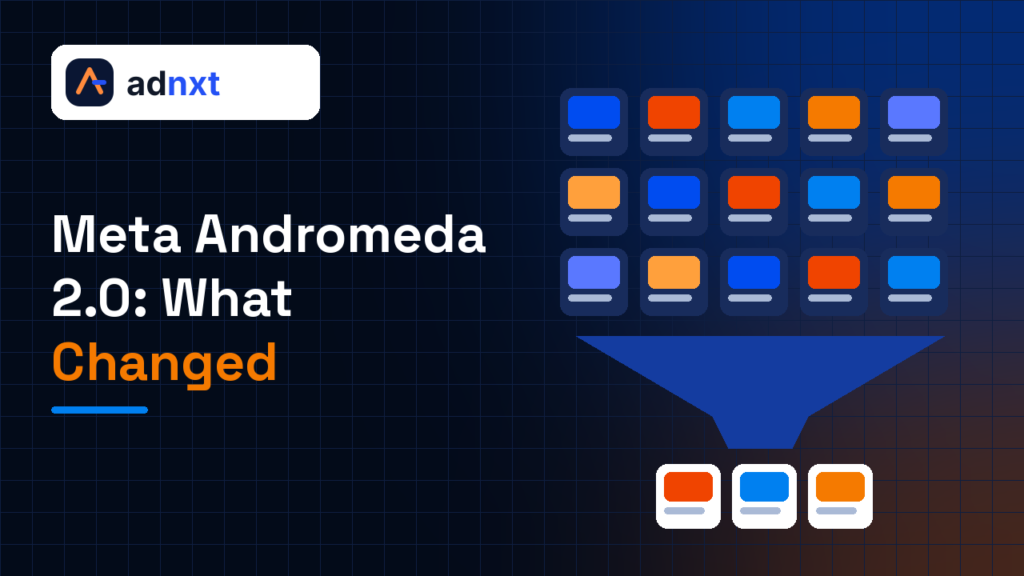
Meta Andromeda is the system that decides which ads are even considered for each person on Facebook and Instagram. On October 28, 2026, Meta described a new generation of it, which marketers now call “Andromeda 2.0.” It can look at a much larger pool of ads and use richer signals about what each person is interested in. For advertisers, the practical change is simple. Your creative now does more of the targeting work. Ads need to be clearly different from each other, speak to specific buying reasons, and make the offer easy to understand in a second.
This guide explains what Meta actually announced, what it does not say, and how to adjust your Meta ads without wrecking a working account. It builds on a recent video by ecommerce media buyer Antonio Ventre and adds Meta’s own documentation, independent coverage and practical steps for small and mid-sized businesses in the US and Canada.
Key takeaways
- “Andromeda 2.0” is a nickname. Meta calls it the next generation of Meta Andromeda, its ad retrieval engine.
- Meta says the new system scores every eligible ad and surfaces top candidates at over one billion ads per second, about 100 times the 2024 version.
- There is no Andromeda setting to switch on. It works behind the scenes for every advertiser.
- Meta’s long-standing advice is creative diversification: ads with different themes, messages and visuals, not small tweaks of one idea.
- Build creative around buying reasons, situations and objections. Keep account structure simple, and measure real business results.
Why so many advertisers are searching for this
We looked at YouTube search demand on November 14, 2026, using Google Trends with the YouTube Search filter. In the United States over the past 30 days, “meta ads andromeda” was a Breakout rising query for “meta ads”, and “meta andromeda” was up 160%. Over the past 90 days, “meta andromeda 2.0” appeared as a Breakout query, and “meta andromeda update” was up 50%. YouTube search interest in “meta ads” itself was also higher in early November than it was in August.
These are relative numbers, not view counts. Rising search demand is not the same thing as how popular any one video is. Still, a search for YouTube’s results on “meta andromeda”, sorted by upload date, showed several new videos about Andromeda 2.0 from different creators within the past two weeks. Advertisers clearly want to know what changed and what to do about it.
The video behind this guide
This article builds on “Meta Andromeda 2.0 IS HERE, What Changes Now?” by Antonio Ventre, published on his YouTube channel on October 29, 2026. Ventre runs an agency that manages Meta ads for ecommerce brands. In the video, he walks through Meta’s October 28 announcement and explains how he plans to change creative testing and account structure. AdNxt is not affiliated with him. We have reviewed the full video and turned the main ideas into a practical guide, with Meta’s own sources added and the speculative parts clearly labeled. Watch the original on YouTube.
What Meta Andromeda is, in plain English
When someone opens Facebook or Instagram, there may be millions of ads that could legally be shown to them. Meta cannot score every one of those with its biggest, slowest models in the split second before a feed loads. So it works in stages.
- Retrieval. A fast system picks a shortlist of ads that look relevant to this person right now. This is Andromeda.
- Ranking. Larger models score that shortlist in more detail and predict how likely the person is to click, buy or sign up.
- Auction and delivery. The ads compete in the auction, and the winners show up in the feed, Stories or Reels.
Meta first described Andromeda in December 2024. It said the retrieval stage narrows tens of millions of ad candidates down to a few thousand relevant ones. The key point for advertisers: if your ad does not make the shortlist, it never reaches the auction. Ventre makes the same point in the video. An ad that misses the shortlist cannot win, no matter how good your bid is.
What changed in October 2026
Meta’s engineering post, published October 28, 2026, describes “the 2026 Meta Andromeda.” The post is technical, but a few changes matter for marketers.
It can handle a much bigger pool of ads
Meta says generative AI tools have helped advertisers create hundreds of millions of new ads, growing its pool of ad candidates to an unprecedented scale. The new system scores every eligible ad and surfaces top candidates at over one billion ads per second, which Meta describes as about 100 times the throughput of the 2024 version.
It looks at people’s interests in more than one way
The 2024 system used a single model to represent each person. The new version uses a group of specialized models, a “mixture of experts,” meant to capture a person’s different and changing interests. Meta also lists richer signals, including recent ad engagement, groups of similar people, meanings drawn from large language models, and activity across different Meta apps.
In everyday terms, the system has a better picture of the fact that one person can care about several things at once. Ventre’s example in the video is a skincare buyer who wants a fast morning routine, proof that a product works, and a price that makes sense. Those are three different reasons to buy, and the same person might respond to all three.
It reads the context of each ad better
Meta says candidate ads are now encoded with real-time context, so the later ranking models get richer information. This supports the idea that what your ad shows and says matters more than ever.
Meta’s reported result
Meta says Andromeda has delivered a 2.4% increase in conversions on Facebook since 2025. That is Meta’s own figure. The post gives no breakdown by industry or account size, so it should not be read as a promise for any single advertiser.
What Meta did not say
A lot of “Andromeda 2.0” content online goes further than Meta’s post. It is worth being clear about the gaps.
- Meta did not call it “2.0.” That is an industry label.
- There is no switch. Andromeda works inside Meta’s delivery system. You cannot turn it on or off.
- The post gives no new advertiser instructions. It says advertisers should get better performance automatically from the retrieval system. Meta’s practical advice still comes from its earlier creative diversification guidance.
- It does not say targeting no longer matters. Location, age and other business limits still apply, and some products and industries must follow strict ad rules.
In the video, Ventre suggests that Meta may now need to spend less budget on an ad before it can judge whether that ad will work, because it can match ads to people earlier. That is his reading of the announcement, not something Meta states directly. It is a reasonable idea to watch for in your own data, but treat it as a hypothesis.
Creative diversification: Meta’s advice still applies
In April 2025, Meta published “The Creative Advantage: Unlocking the Power of Diversification with Meta Andromeda.” It defines creative diversification as creating a wide range of ad creatives with different themes, messages and visuals to reach different audience segments. Meta says the focus has shifted from niche targeting to creative diversification as the best lever to find the most relevant audiences.
The new Andromeda makes this advice more important, not less. A bigger candidate pool and a better understanding of each person’s interests reward advertisers who give the system truly different options.
Here is the catch. Diversification does not mean more ads. Ten versions of the same photo with different headline colors are not ten ideas. They are one idea in ten outfits. Different ideas look and sound different because they speak to different reasons someone might buy.
How to build diverse creative: reasons, situations and objections
Ventre’s most useful idea in the video is to break each broad angle into smaller, more specific parts. Instead of testing “improve sleep” as one angle for a supplement brand, he breaks it down three ways.
Motivations: why they want it
For better sleep, motivations might be to stay focused at work, wake up with energy, or be more patient with family. Each motivation can lead an ad.
Situations: when the problem shows up
Situations might be a racing mind after a stressful day, lying awake before an early alarm, or waking up at 3 a.m. Each situation can be the opening scene of an ad.
Objections: what makes them hesitate
Objections might be “Will this work for me?”, “I tried other products and they didn’t help,” or “How long until I notice a difference?” Each objection can be answered in its own ad.
This framework works well beyond ecommerce. Here is a hypothetical example for a home cleaning service in Vancouver:
- Motivations: more time with family on weekends, a clean home before guests arrive, less arguing about chores.
- Situations: the Friday night before hosting a dinner, moving out and needing the deposit back, a new baby at home.
- Objections: “Can I trust strangers in my home?”, “Will they actually clean properly?”, “Is it worth the price?”
From that list, you could build an ad showing a real cleaner arriving on a Friday evening, a short video answering the trust question with staff screening details, and a static ad breaking down what a standard clean includes and what it costs. Those are three different ideas, not three versions of one.
Questions to answer for every new ad
Ventre suggests answering a few questions before making any ad. They are a good habit:
- What will we learn from testing this ad?
- Who is it for?
- What situation or problem does it address?
- What reason to buy does it bring in?
- What evidence supports the message?
If you cannot answer these, the ad is probably a variation, not a new concept.
Match each idea to the right format
Ventre also warns against judging an idea after testing it in only one format. If a “proof it works” angle fails as a plain static image, the problem might be the format, not the idea. That same angle might work as a customer testimonial video or a before-and-after carousel.
A simple way to match formats to ideas:
- Proof and trust: real customer videos, reviews shown accurately, short behind-the-scenes clips.
- How it works: short demo videos, step-by-step carousels.
- Price and value: clear static ads that explain what is included and what it costs, or the cost per use.
- Situations: short videos that open on the exact moment the problem shows up.
Once a concept shows promise, then test smaller changes such as hooks, opening shots, captions and headlines. As Ventre puts it, find the promising concept first, then improve how it is presented.
A note on honesty: only use real customer reviews and testimonials, with permission, and never edit what a customer said. In the US, the FTC’s rule on consumer reviews and testimonials bans fake reviews and testimonials, including AI-generated ones. Meta’s advertising standards also apply.
Keep your account structure simple
A better retrieval system works best when it has enough data in one place. Many advertisers have moved toward fewer, broader campaigns and ad sets over the past two years, and the new Andromeda supports that direction.
In the video, Ventre recommends one ad set per persona with several angles and formats inside it, rather than a separate ad set for every angle. His reasoning is that Meta can then learn how to show different angles to the same type of person over time. This is his approach for ecommerce clients, and it makes sense for many accounts. For a small business, it often means:
- One prospecting campaign with broad targeting and your business limits, such as location.
- Ad sets split only when there is a real reason, such as a very different customer type, product line or region.
- A handful of truly different concepts in each ad set, each in a fitting format.
How many ads do you need? There is no magic number. A small local service business may do well with three to five genuinely different concepts. A larger ecommerce brand may test many more each month. Quality and difference matter more than count.
Balance engagement and conversion
The last point in the video is that winning ads need to do two jobs: hold attention and drive action. Ventre argues that an ad which is all offer and no interest, or all entertainment and no sale, will struggle. That is his view based on his accounts, but it matches what Meta’s post describes. The system uses engagement signals as well as conversions to understand people.
In practice, open with something that earns attention, such as a real situation, a surprising fact you can back up, or a clear visual. Then make the offer and the next step obvious. For lead generation businesses, that might mean a short video that shows the problem, explains your solution simply, and ends with a clear call to book or call.
Feed the system clean conversion data
Andromeda chooses which ads to consider, but the ranking and bidding stages still depend on knowing which ads drive results. If Meta learns from bad data, it will optimize for the wrong thing.
- Set up the Meta Pixel and the Conversions API so key events are tracked reliably, with deduplication between browser and server events. Meta’s developer documentation explains how.
- Optimize for the event that matters most, such as purchases or qualified leads, not page views or link clicks.
- For lead generation, send lead quality back to Meta where you can, so it learns the difference between a real prospect and spam.
- Compare Meta’s reported results with your CRM, store or booking system.
What not to do in response to Andromeda
- Do not rebuild your whole account overnight. Big structural changes during the holiday season can reset learning when you need stability most. Meta’s own peak season guidance encourages fewer disruptive account changes.
- Do not flood the account with near-copies of one ad. That adds volume without adding real diversity.
- Do not blame every bad week on Andromeda. Check your tracking, offer, landing page, budget and seasonality first.
- Do not trust AI-generated ads blindly. Review every generated image and line of copy for accuracy and claims you cannot support.
- Do not drop the limits your business needs. Keep location and other real constraints in place.
A simple 30-day plan for small advertisers
Week 1: Audit
- Check that your Pixel and Conversions API are working and that you optimize for the right event.
- List the ads you currently run and group them by real concept. Many accounts find they have only two or three true ideas.
- Write down your customers’ main motivations, situations and objections, using reviews, sales calls and support questions.
Week 2: Create
- Pick three to five new concepts that cover different buying reasons.
- Choose a format that fits each one.
- Make sure every ad shows the product or service clearly and explains the offer in plain words.
Week 3: Launch and watch
- Add the new ads to your existing structure instead of rebuilding.
- Keep budgets steady while the system learns.
- Watch which concepts get spend and results.
Week 4: Learn and iterate
- For concepts that work, test new hooks and openings.
- For concepts that fail, ask whether the idea or the format was the problem before you drop it.
- Compare results with your actual sales or qualified leads.
If you also run static ads that lead to articles or landing pages, our guide on Meta static ads that lead to articles shows how to keep that funnel honest and effective.
Frequently asked questions
What is Meta Andromeda 2.0?
It is the industry name for the next generation of Meta Andromeda, which Meta described on October 28, 2026. Andromeda is the system that picks a shortlist of relevant ads for each person before Meta’s ranking and auction stages. The new version can evaluate far more ads and uses richer signals about people’s interests.
Do I need to change anything in Ads Manager for Andromeda?
There is no Andromeda setting. The changes happen inside Meta’s systems. What you can control is your creative, your account structure and your conversion tracking.
Is audience targeting dead on Meta?
No. Meta says creative diversification is now the best lever to find relevant audiences, but targeting still matters for real business limits, such as where you operate, and for any industry rules you must follow.
How many ads should I run after the Andromeda update?
There is no official number. Focus on running genuinely different concepts rather than many near-copies. Small businesses can start with three to five clearly different ideas and build from there.
Why are some of my ads getting no spend?
Meta concentrates budget on the ads it predicts will perform best. Ads that look very similar to others, or that the system does not see as relevant, may get little delivery. Check whether the ad is truly different, whether the format suits the idea, and whether enough time has passed to judge.
Does Andromeda affect Instagram ads too?
Yes. Andromeda is part of Meta’s ads system across Facebook and Instagram.
Final thoughts
The new Andromeda does not ask advertisers to learn a new tool. It raises the bar on the one thing advertisers have always controlled: the ads themselves. Build ads around real buying reasons, situations and objections. Match each idea to a format that explains it well. Keep your structure simple, feed Meta clean conversion data, and judge results by real sales and leads. That approach works with Andromeda instead of against it.
If you want help building a creative testing plan, cleaning up tracking, or managing Meta campaigns through the holiday season, our Meta ads team can help.
How this guide was made: AdNxt researched this topic using the public sources listed below and drafted it with AI assistance. Facts, dates and figures were checked against those sources at the time of publication. Read our AI-assisted content policy and editorial policy, or report a correction.
Related AdNxt guides
- Meta static ads that lead to articles: an honest advertorial funnel playbook
- Cyber Monday 2026: the store and ad checklist for the final two weeks
- Black Friday 2026 in Canada: a marketing guide for Canadian businesses
- GA4 conversion tracking for small businesses
Sources and further reading
- Antonio Ventre, “Meta Andromeda 2.0 IS HERE, What Changes Now?” (YouTube, October 29, 2026)
- Engineering at Meta: the next generation of Meta Andromeda (October 28, 2026)
- Engineering at Meta: Meta Andromeda, next-gen personalized ads retrieval engine (December 2, 2024)
- Meta for Business: The Creative Advantage: Unlocking the Power of Diversification with Meta Andromeda (April 22, 2025)
- Meta for Developers: Conversions API
- PPC Land: Meta says Andromeda lifted Facebook conversions 2.4% since 2025
- Google Trends: Meta ads searches on YouTube, United States, past 90 days