
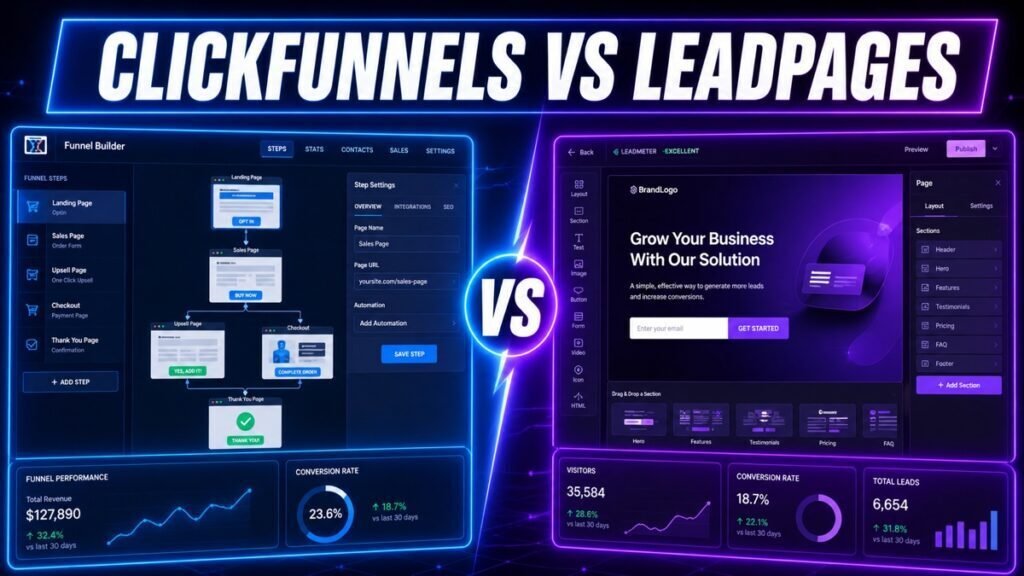
These two get compared as though they are the same product at different prices. They are not, and the price gap between them is the clearest signal of the difference.
Leadpages builds pages. ClickFunnels builds funnels — sequences of pages with a checkout, order bumps, upsells and email attached. If you only need pages, ClickFunnels is expensive and you will not use most of it. If you need the checkout and upsell machinery, Leadpages does not have it and bolting it together yourself is worse than paying.
The Structural Difference
Leadpages is a landing page builder with strong conversion tooling: templates, A/B testing, pop-ups, alert bars, lead capture. You point it at your existing email platform and payment processor, and it does one job well.
ClickFunnels is a business-in-a-box. Pages, but also order forms, one-click upsells and downsells, order bumps, membership areas, email automation, affiliate management and a CRM. The pages are a component rather than the product.
The practical test: does money change hands on your page, and do you want to sell something else immediately afterwards? If yes, ClickFunnels. If you are capturing leads and selling later by other means, Leadpages.
Where Leadpages Wins
Cost, substantially
Leadpages sits at a materially lower price point. For a business capturing leads, that gap over a year is real money that buys advertising instead.
Page quality and speed
Leadpages’ templates are cleaner, and pages tend to load faster. That matters more than it sounds — page speed affects both conversion and your ad quality scores, so a slow funnel page costs you twice.
It plays nicely with what you already have
Leadpages assumes you have an email platform and a payment processor and connects to them. ClickFunnels prefers you to use its own, which is convenient until you want to leave.
Simplicity
You can publish a good landing page in an afternoon. ClickFunnels expects you to think in funnels before you build anything.
Where ClickFunnels Wins
One-click upsells and order bumps
The genuine capability gap. After someone enters card details, ClickFunnels can offer an additional product they accept with a single click — no re-entering payment information. Order bumps add a checkbox at checkout.
These measurably increase average order value, and Leadpages has no equivalent. This alone justifies the price difference for businesses that sell this way.
Complete funnel logic
Multi-step sequences with conditional paths, built as one object rather than assembled from separate pages you have to wire together.
Membership areas
Gated content delivery included, so a course or membership does not need a separate platform.
Everything in one system
Email, CRM, affiliate management and checkout under one login. If it genuinely replaces four subscriptions, the maths changes.
Head to Head
| Leadpages | ClickFunnels | |
|---|---|---|
| Core purpose | Landing pages | Sales funnels |
| One-click upsells | No | Yes |
| Order bumps | No | Yes |
| Built-in checkout | Basic | Full |
| Email marketing | Connects to yours | Built in |
| Membership areas | No | Yes |
| Affiliate management | No | Yes |
| A/B testing | Yes | Yes |
| Page load speed | Generally faster | Heavier |
| Learning curve | Low | Moderate |
| Relative cost | Lower | Substantially higher |
Both price in tiers and both have restructured pricing more than once. Verify current pricing directly, and price the tier that includes what you actually need — ClickFunnels’ more useful features have historically sat above the entry plan.
The Third Option Nobody Mentions
If you already run WordPress, a page builder plus a checkout plugin covers a lot of this at a fraction of the cost, and you own the pages.
Similarly, if you sell courses, platforms like Kajabi include funnels, checkout and membership, so buying ClickFunnels alongside one is duplicating spend.
Neither is a universal answer, but both are worth pricing before committing to a funnel platform subscription.
Which Should You Choose?
Choose Leadpages if: you capture leads and sell through conversation, sales calls or email; you already have an email platform you like; you want fast pages at a sensible price; or you publish landing pages for content and campaigns rather than direct-response offers.
Choose ClickFunnels if: you sell products directly from the page; upsells and order bumps would genuinely raise your average order value; you run memberships or courses; or you want one system and will actually cancel the tools it replaces.
Tiebreaker: if you cannot name the upsell you would offer after checkout, you do not need ClickFunnels yet.
Common Mistakes to Avoid
- Buying ClickFunnels for pages. The most common and most expensive error. If you are not using upsells, checkout and membership, you are paying several times over for a page builder.
- Not cancelling what it replaces. The all-in-one argument only works if you actually stop paying for the separate email tool.
- Ignoring page speed. Heavier pages convert worse and can raise your ad costs. Test both on mobile with a real speed tool.
- Building the funnel before validating the offer. A sophisticated funnel around an offer nobody wants converts nothing. Sell it manually first.
- Locking your list inside a funnel platform. If your email lives in ClickFunnels, leaving becomes harder. Consider keeping your list in a dedicated email platform.
- Copying a template funnel wholesale. Templates set structure, not messaging. The copy is what converts.
- Forgetting compliance. Order bumps and upsells must be clearly disclosed and not pre-ticked in ways that mislead. Consumer protection rules on this are enforced in the US, UK and EU.
FAQs
Is ClickFunnels worth the price?
If you sell directly from your pages and would use upsells, order bumps and membership areas, often yes — the increase in average order value can cover it. If you are capturing leads and selling elsewhere, it is poor value against Leadpages or a WordPress setup.
Can Leadpages do checkout?
It supports basic payment collection, but it has no one-click upsells or order bumps. For direct-response selling with post-purchase offers, that gap is the reason people move to ClickFunnels.
Which is better for beginners?
Leadpages. You can publish a competent page in an afternoon. ClickFunnels asks you to design a funnel before you build anything, which is a bigger conceptual step.
Do I need either if I have WordPress?
Often not. A page builder plus a checkout plugin covers most landing page and simple sales needs, and you own the result. The case for ClickFunnels specifically is the upsell and membership machinery.
Which loads faster?
Leadpages pages are generally lighter. This matters for conversion and for ad platform quality scores. Test your own built pages rather than the vendors’ marketing sites.
Can I move my funnels between them?
No. Pages, funnels and automations do not transfer between platforms in any direction. Everything is rebuilt by hand, which is worth knowing before you build fifty pages.
Key Takeaways
- Leadpages builds pages; ClickFunnels builds funnels with checkout, upsells and membership.
- One-click upsells and order bumps are the real capability gap and the reason for the price difference.
- If you cannot name your post-purchase upsell, you do not need ClickFunnels.
- The all-in-one argument only pays off if you cancel the tools it replaces.
- If you already run WordPress, price a page builder plus checkout plugin before either.
Making the Call
Write down what happens in the sixty seconds after someone pays you. If the answer is “nothing, we deliver the product,” Leadpages. If the answer is “we offer them the next thing,” ClickFunnels earns its price.
For adjacent decisions, our guides to course platforms and website builders cover options that may already include what you are about to buy separately.